
Search
Remove Ads
Advertisement
Search Results

Definition
Xochicalco
Xochicalco in central Mexico was an important hilltop centre from the 8th century CE and was a rival and successor of Teotihuacán. Architecture at the site is closely connected to that of the Classic Maya, Teotihuacan, and Veracruz...

Definition
Seven Lucky Gods
In Japanese folklore the Shichifukujin are the Seven Lucky Gods who may also be known as the Seven Gods of Happiness or the Seven Gods of Good Fortune. The seven gods are in fact of diverse origin as some are originally from Buddhism...

Definition
Tenochtitlan
Tenochtitlan (also spelled Tenochtitlán), located on an island near the western shore of Lake Texcoco in central Mexico, was the capital city and religious centre of the Aztec civilization. The traditional founding date of the city...

Definition
Inca Civilization
The Inca civilization flourished in ancient Peru between c. 1400 and 1533 CE. The Inca Empire eventually extended across western South America from Quito in the north to Santiago in the south. It was the largest empire ever seen...
Definition
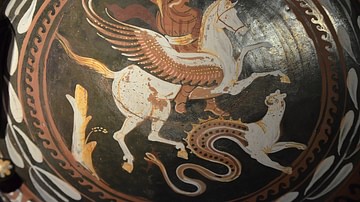
Bellerophon
Bellerophon (aka Bellerophontes) is the Corinthian hero of Greek mythology who famously battled and killed the fantastical Chimera monster, a fearsome fire-breathing mix of lion, goat, and snake. Bellerophon was the son of Poseidon...

Definition
Etruscan Language
The language of the Etruscans, like the people themselves, has remained somewhat mysterious and has yet to be fully understood. The alphabet used a western Greek script, but the language has presented difficulties to scholars...

Definition
Khitan
The Khitan people formed the Liao dynasty and ruled parts of Mongolia, Manchuria, and northern China from 907 to 1125 CE. Adopting elements of Chinese government and culture, the Khitan were more than a match for their rivals the Song...

Definition
Florentine Codex - An Encyclopedia of Life in 16th-Century Mexico
The Florentine Codex is an encyclopedic accounting of life in 16th-century Mexico and an invaluable resource for understanding the exchange between European and Indigenous cultures during...

Article
Ten Great Native American Mound Sites
The Native Americans of Pre-Colonial North America built thousands of mounds across the continent which served various purposes and sometimes reached heights over 100 feet. Many of the mound sites were thriving...

Article
A Medieval Christmas - A History of Seasonal Traditions
Christmas was one of the highlights of the medieval calendar, not only for the rich but also for the peasantry. For the longest holiday of the year, typically the full twelve days of Christmas, people...
