
Search
Search Results
Definition
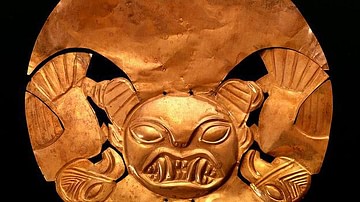
Moche Civilization
The Moche civilization (also known as the Mochica) flourished along the northern coast and valleys of ancient Peru, in particular, in the Chicama and Trujillo Valleys, between 1 CE and 800 CE. The Moche state spread to eventually cover an...

Definition
Silla
The Silla kingdom ruled south-eastern Korea during the Three Kingdoms period from the 1st century BCE to 7th century CE. The capital was Geumseong (Gyeongju) with a centralised government and hierarchical system of social ranks. The prosperity...

Definition
Mycenaean Society
Mycenaean society was strictly hierarchical, valued family lineage, and awarded higher social status to those involved with religious or military activities and palatial administration. The lower classes contained craftsmen and artisans who...

Definition
Carnac
Carnac, located on the north-west coast of France, is the site of the largest concentration of megalithic monuments in the world. Over 100 monuments, which include burial mounds, stone tombs, enclosures, and linear arrangements of menhirs...
Definition
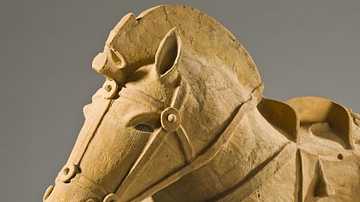
Haniwa
Haniwa are the unglazed terracotta rings, cylinders, and figures of people, animals, and houses which were deposited at Japanese tombs during the Kofun and Asuka Periods (c. 250-710 CE). The exact purpose of these offerings is not known...

Definition
Long Barrow
A long barrow is a class of Middle Neolithic (approximately 3500-2700 BCE) burial monument which is found extensively throughout the British Isles and is related to other forms of contemporary tomb-building traditions of north-western Europe...

Definition
Gyeongju
Gyeongju (Kyongju), formerly known as Seorabeol or Saro, was the capital of the Silla kingdom of ancient Korea from the 1st century BCE to the 10th century CE. Located in the south-east of the Korean peninsula, at its peak in the 9th century...

Definition
Lambayeque Civilization
The Lambayeque civilization (aka Sicán) flourished between c. 750 and c. 1375 CE on the northern coast of Peru, straddling the Middle Horizon and Late Intermediate Period of the ancient Central Andes. Prodigious producers of art objects...

Definition
Ziggurat - Mountains of the Gods
A ziggurat is a form of monumental architecture originating in ancient Mesopotamia, which usually had a rectangular base and was built in a series of steps up to a flat platform upon which a temple was raised. The ziggurat was an artificial...

Image
Mound B, Etowah
Mound B at Etowah, Georgia, USA. The Etowah Mounds were built in three stages during the period of the Mississippian Culture, c. 1000-1550 CE.
