
Search
Remove Ads
Advertisement
Search Results
Definition
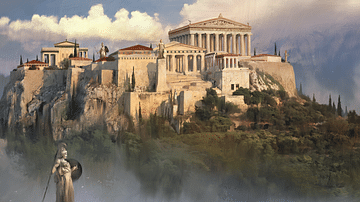
Acropolis
An acropolis is any citadel or complex built on a high hill. The name derives from the Greek akro, "high" or "extreme/extremity" or "edge", and polis, "city", translated as "high city", "city on the edge" or "city in the air", the most famous...

Definition
Temple
A temple (from the Latin templum) is a structure usually built for the purpose of, and always dedicated to, religious or spiritual activities including prayer, meditation, sacrifice and worship. The templum was a sacred precinct defined by...

3D Image
Cahokia Pottery Specimen
An example of Cahokia pottery from c. 1000 CE created from an augmented reality app.

Article
Harappa: An Overview of Harappan Architecture & Town Planning
Harappa is a large village presently in the province of Punjab in Pakistan. The modern town is a part of and lies next to the ancient city. The site of Harappa is important in that it has provided proof of not just the Indus Valley Civilization...
Article
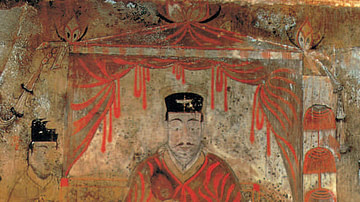
The Tombs of Goguryeo
Goguryeo (Koguryo) ruled northern Korea during the Three Kingdoms period from the 1st century BCE to 7th century CE, and the best evidence of the kingdom's prosperity and artistry can be found in the many surviving tombs of the period. The...
Image
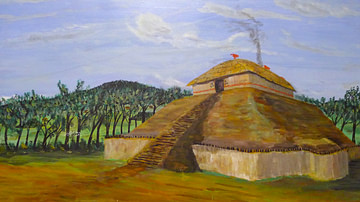
Impression of Mound C, Etowah
A painting by archaeologist Robert Neitzel, former curator of the Etowah Mounds site, illustrating how Mound C might have looked when it was used as a platform for a building. The building was probably an ossuary for the bones of the elite/leaders...
Image
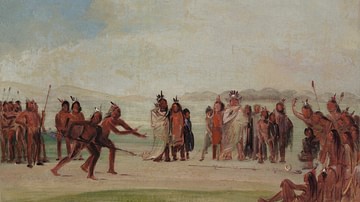
Tchung-kee, a Mandan Game Played with a Ring and Pole
Tchung-kee, a Mandan Game Played with a Ring and Pole, oil on canvas by artist George Catlin, 1832-1833. Chunkey was a popular team sport among many Native American Nations and is thought to have originated c. 600 CE at Cahokia. Smithsonian...
Definition
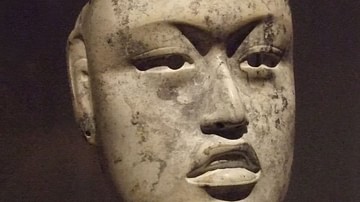
Olmec Civilization
The Olmec civilization, located in ancient Mexico, prospered in Pre-Classical (Formative) Mesoamerica from c. 1200 BCE to c. 400 BCE. Monumental sacred complexes, massive stone sculptures, ball games, the drinking of chocolate, and animal...

Definition
Silla
The Silla kingdom ruled south-eastern Korea during the Three Kingdoms period from the 1st century BCE to 7th century CE. The capital was Geumseong (Gyeongju) with a centralised government and hierarchical system of social ranks. The prosperity...
Definition
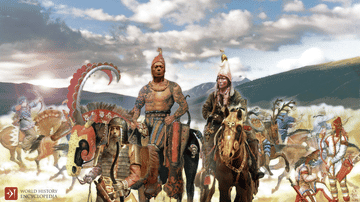
Scythians
The Scythians were a nomadic people whose culture flourished between the 7th and 3rd century BCE in a territory ranging from Thrace in the west, across the steppe of Central Asia, to the Altai Mountains of Mongolia in the east. This covers...
