
Search
Remove Ads
Advertisement
Search Results

Definition
Bone Rank System
The Bone Rank System (Golpum or Kolpum) of ancient Korea was used in the Silla kingdom (57 BCE – 935 CE) in order to signal a person's political rank and social status. Membership of a particular rank within the system was extremely...
Definition
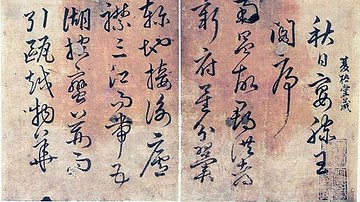
Hanji
Hanji is the name of the handmade paper produced in ancient Korea from the 1st century BCE. Made from mulberry trees its exceptional quality made it a successful export, and it was widely used not only for writing but also interior walls...

Article
Korean Celadon Pottery
The celadon (or greenware) ceramics produced in ancient Korea during the Goryeo Dynasty (918-1392 CE), are regarded as some of the finest and most elegant pottery pieces produced anywhere. With a pale green lustre reminiscent...

Article
The Gold Crowns of Silla
The Silla Kingdom ruled south-eastern Korea during the Three Kingdoms period (1st century BCE - 7th century CE) and then, as the Unified Silla Kingdom, all of Korea from 668 to 935 CE. The Silla produced fine pieces of...

Lesson Pack
Ancient Korea
Detailed lesson plan on ancient Korea, divided into three units with varied materials, sources, and ready-to-print activities. Homework, assessment and all keys included. Table of Contents - Unit 1: The...
Image
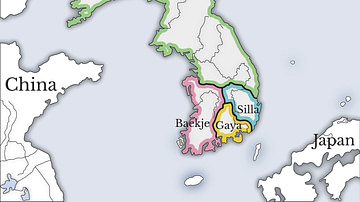
Three Kingdoms of Korea Map
A map showing the three kingdoms (Goguryeo, Silla, and Baekje) and the Gaya confederation which ruled Korea between the 1st and 7th century CE.
Image
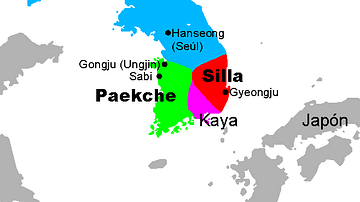
Three Kingdoms, Korea
A map showing the Three kingdoms of ancient Korea (57 BCE - 668 CE): Baekje (Paekche), Goguryeo (Koguryo), and Silla. There was also a fourth entity in this period, the Gaya (Kaya) Confederation.
Definition
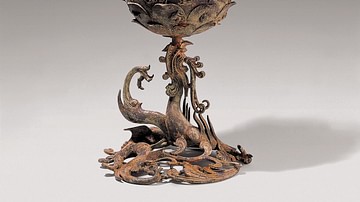
Baekje
Baekje (Paekche) was one of the Three Kingdoms which ruled over ancient Korea from the 1st century BCE to the 7th century CE. Controlling territory in the south-western part of the peninsula the kingdom was in constant rivalry with the...

Definition
Asuka Period
The Asuka Period (Asuka Jidai) of ancient Japan covers the period from 538 CE to 710 CE and, following on from the Kofun Period (c. 250-538 CE), so constitutes the latter part of the Yamato Period (c. 250-710 CE). For some scholars...

Definition
Unified Silla Kingdom
The Unified Silla Kingdom (668- 935 CE) was the first dynasty to rule over the whole of the Korean peninsula. After centuries of battles with the other states of the Three Kingdoms Period (57 BCE - 668 CE) Silla benefitted...
