
Search
Remove Ads
Advertisement
Search Results

Definition
Ajanta
Approximately 67 miles (107 km) to the north of Aurangabad in the Indhyadri range of Western Ghats lie the caves of Ajanta. The 30 caves, famous for their early Buddhist temple architecture and many delicately drawn murals, are located...
Definition
Gwanggaeto the Great
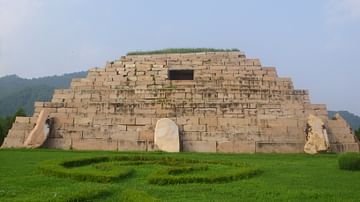
Gwanggaeto (Kwanggaeto), often referred to as Gwanggaeto the Great, was king of the Goguryeo (Koguryo) kingdom which ruled northern Korea during the Three Kingdoms period. Gwanggaeto reigned between 391 and 413 CE, and living...

Definition
Ancient Pyongyang
Pyongyang (aka Pyeongyang) was the capital of several successive ancient Korean kingdoms. Located on the Daedong River in the north of the peninsula, the site was chosen by the legendary Dangun (Tangun), founder of the first...

Interview
Interview: Buddhism in Korea
In this interview, James Blake Wiener, Co-Founder and Communications Director at Ancient History Encyclopedia (AHE), speaks to Emeritus Professor James H. Grayson, Professor of Korean Studies at the University of Sheffield...
Article
The Tomb of King Muryeong
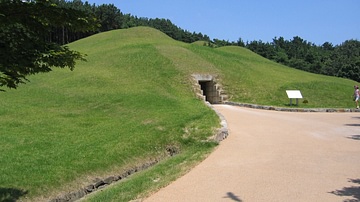
The tomb of king Muryeong is perhaps one of the most impressive tombs from the Baekje kingdom of ancient Korea, both in its design and the treasure found inside it. Muryeong-Wang (also Munyeong or Muryong) reigned from...

Image
East Asia in 500 CE
This map shows the territories of all major civilizations in East Asia in the year 500 CE. Italicized texts indicate nomadic bands or tribal societies.

Video
Confucianism- Korean Culture
Korean Confucianism is one of the most substantial influences in Korean intellectual history. The introduction of Confucian thought in Korea is part of the cultural influence brought from China. Today the legacy of Confucianism...

Video
Haeinsa Temple Janggyeong Panjeon, the Depositories for ... (UNESCO/NHK)
The Temple of Haeinsa, on Mount Gaya, is home to the Tripitaka Koreana , the most complete collection of Buddhist texts, engraved on 80,000 woodblocks between 1237 and 1248 A.D. The...
