
Search
Remove Ads
Advertisement
Search Results
Definition
Giants
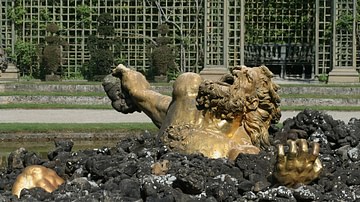
In Greek mythology, the Giants (Gigantes) are an aggressive race of creatures who were born from Gaia (the Earth) after drops of Uranus' blood fell on the Earth after he was castrated. The Giants had great strength and were fearsome to...

Definition
Charles Cornwallis
Charles Cornwallis (1738-1805), 1st Marquess and 2nd Earl Cornwallis, was a British military officer and statesman best known for surrendering to George Washington at the Siege of Yorktown, the final decisive engagement of the...

Definition
Alexander Hamilton
Alexander Hamilton (1755/57-1804) was a lawyer and politician, often recognized as a Founding Father of the United States. He served as George Washington's aide-de-camp during the American Revolution, before going on to become...

Definition
Aaron Burr
Aaron Burr (1756-1836) was an American politician and lawyer, who served as the third vice president of the United States (1801-1805). His reputation as a US Founding Father was marred by his killing of political rival Alexander Hamilton...

Definition
Louis XIV of France - The Sun King
Louis XIV (1638-1715) reigned as King of France from 1643 to 1715. Known as Le Roi Soleil ('the Sun King'), he fervently believed in the concept of the 'divine right' of kings and is remembered for ruling as an absolute...

Definition
Gaul
Gaul (Latin Gallia, French Gaule) is the name given by the Romans to the territories where the Celtic Gauls (Latin Galli, French Gaulois) lived, including present France, Belgium, Luxemburg and parts of the Netherlands, Switzerland, Germany...

Definition
Toltec Civilization
The Toltec civilization flourished in ancient central Mexico between the 10th and mid-12th centuries. Continuing the Mesoamerican heritage left to them by earlier cultures, the Toltecs built an impressive capital at Tollan...

Definition
Byzantine Art
Byzantine art (4th - 15th century CE) is generally characterised by a move away from the naturalism of the Classical tradition towards the more abstract and universal, there is a definite preference for two-dimensional representations...

Definition
Avars
The Avars were a confederation of heterogeneous (diverse or varied) people consisting of Rouran, Hephthalites, and Turkic-Oghuric races who migrated to the region of the Pontic Grass Steppe (an area corresponding to modern-day Ukraine...

Definition
The Saxons
The Saxons were a Germanic people of the region north of the Elbe River stretching from Holstein (in modern-day Germany) to the North Sea. The Saxons who migrated to Britain in the 5th and 6th centuries CE along with the Angles, Frisians...
