
Search
Remove Ads
Advertisement
Search Results
Article
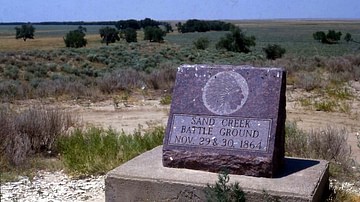
Early Media Coverage of the Sand Creek Massacre and Continuing Controversy
The earliest reports on the Sand Creek Massacre (29 November 1864) characterized it as a great battle in which the Third Colorado Cavalry under Colonel John Chivington defeated a...

Definition
Livia Drusilla
Livia Drusilla (58 BCE - 29 CE) was the third wife of emperor Augustus of Rome, mother of emperor Tiberius, and grandmother of emperor Claudius. She was one of the great women in history who achieved prominence living in the shadow...

Definition
Aetolian League
The Aetolian League was an ancient Greek alliance of the tribes that lived west of Athens and north of the Peloponnese. The league was probably first established in the early 4th century BCE, reached its peak during the Hellenistic...

Article
Elephants in Greek & Roman Warfare
In the search for ever more impressive and lethal weapons to shock the enemy and bring total victory the armies of ancient Greece, Carthage, and even sometimes Rome turned to the elephant. Huge, exotic, and frightening...

Definition
Alfred the Great
Alfred the Great (r. 871-899) was the king of Wessex in Britain but came to be known as King of the Anglo-Saxons after his military victories over Viking adversaries and later successful negotiations with them. He is the best-known...

Definition
New Model Army
The New Model Army was created in February 1645 by the Parliamentarians during the English Civil Wars (1642-1651) that turned England from a monarchy to a republic. It was a professional army in terms of its personnel, training...

Definition
Alexander the Great
Alexander III of Macedon, better known as Alexander the Great (l. 21 July 356 BCE – 10 or 11 June 323 BCE, r. 336-323 BCE), was the son of King Philip II of Macedon (r. 359-336 BCE) who became king upon his father's death in...
Definition
Attila the Hun
Attila the Hun (r. 434-453 CE) was the leader of the ancient nomadic people known as the Huns and ruler of the Hunnic Empire, which he established. His name means "Little Father" and, according to some historians, may not have...

Definition
William Wallace
Sir William Wallace (c. 1270-1305) was a Scottish knight and national hero who fought for his country's independence from England. Wallace famously led the Scots to victory against a larger English army at the Battle of Stirling...

Definition
Telesilla of Argos
Telesilla of Argos was a lyric poet of the 5th century BCE, listed by Antipater of Thesalonike (c. 15 BCE) as one of the great Nine Female Lyric Poets of Greece (along with Praxilla, Moiro, Anyte, Sappho, Erinna, Corinna, Nossis...
