
Search
Remove Ads
Advertisement
Search Results
Article
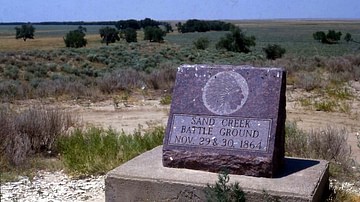
Early Media Coverage of the Sand Creek Massacre and Continuing Controversy
The earliest reports on the Sand Creek Massacre (29 November 1864) characterized it as a great battle in which the Third Colorado Cavalry under Colonel John Chivington defeated a...

Article
Elephants in Greek & Roman Warfare
In the search for ever more impressive and lethal weapons to shock the enemy and bring total victory the armies of ancient Greece, Carthage, and even sometimes Rome turned to the elephant. Huge, exotic, and frightening...

Definition
James II of Scotland
James II of Scotland ruled as king from 1437 to 1460. Succeeding his murdered father James I of Scotland (r. 1406-1437), James inherited the throne as a child. The first part of his reign witnessed intense rivalries between...

Definition
Edward the Black Prince
Edward of Woodstock (1330-1376 CE), better known as the Black Prince after his distinctive armour or martial reputation, was the eldest son of Edward III of England (r. 1327-1377 CE). Made the Prince of Wales in 1343 CE...

Definition
Henry Clinton
Sir Henry Clinton (l. c. 1730-1795) was a British military officer who served as commander-in-chief of the British Army in the later stages of the American Revolutionary War (1775-1783). Having arrived in Boston in May 1775, he...

Definition
Alfred the Great
Alfred the Great (r. 871-899) was the king of Wessex in Britain but came to be known as King of the Anglo-Saxons after his military victories over Viking adversaries and later successful negotiations with them. He is the best-known...

Definition
New Model Army
The New Model Army was created in February 1645 by the Parliamentarians during the English Civil Wars (1642-1651) that turned England from a monarchy to a republic. It was a professional army in terms of its personnel, training...

Definition
Alexander the Great
Alexander III of Macedon, better known as Alexander the Great (l. 21 July 356 BCE – 10 or 11 June 323 BCE, r. 336-323 BCE), was the son of King Philip II of Macedon (r. 359-336 BCE) who became king upon his father's death in...
Definition
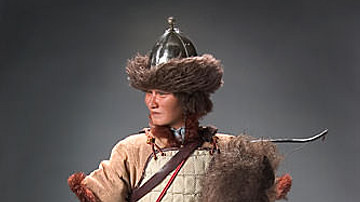
Attila the Hun
Attila the Hun (r. 434-453 CE) was the leader of the ancient nomadic people known as the Huns and ruler of the Hunnic Empire, which he established. His name means "Little Father" and, according to some historians, may not have...

Definition
William Wallace
Sir William Wallace (c. 1270-1305) was a Scottish knight and national hero who fought for his country's independence from England. Wallace famously led the Scots to victory against a larger English army at the Battle of Stirling...
