
Search
Remove Ads
Advertisement
Search Results

Definition
Alexander the Great
Alexander III of Macedon, better known as Alexander the Great (l. 21 July 356 BCE – 10 or 11 June 323 BCE, r. 336-323 BCE), was the son of King Philip II of Macedon (r. 359-336 BCE) who became king upon his father's death in...

Definition
Kahina
Kahina (7th century CE) was a Berber (Imazighen) warrior-queen and seer who led her people against the Arab Invasion of North Africa in the 7th century CE. She is also known as al-Kahina, Dihya al-Kahina, Dahlia, Daya, and Dahia-al-Kahina...

Definition
Alfred the Great
Alfred the Great (r. 871-899) was the king of Wessex in Britain but came to be known as King of the Anglo-Saxons after his military victories over Viking adversaries and later successful negotiations with them. He is the best-known...

Definition
Flann Sinna
Flann Sinna (r. 879-916 CE) was a High King of Ireland from the Kingdom of Mide (Meath) and a member of the Clann Cholmain, a branch of the Southern Ui Neill dynasty. His name is pronounced “Flahn Shinna” and means “Flann of the Shannon”...

Definition
New Model Army
The New Model Army was created in February 1645 by the Parliamentarians during the English Civil Wars (1642-1651) that turned England from a monarchy to a republic. It was a professional army in terms of its personnel, training...

Definition
Henry Clinton
Sir Henry Clinton (l. c. 1730-1795) was a British military officer who served as commander-in-chief of the British Army in the later stages of the American Revolutionary War (1775-1783). Having arrived in Boston in May 1775, he...

Definition
William Wallace
Sir William Wallace (c. 1270-1305) was a Scottish knight and national hero who fought for his country's independence from England. Wallace famously led the Scots to victory against a larger English army at the Battle of Stirling...

Definition
Telesilla of Argos
Telesilla of Argos was a lyric poet of the 5th century BCE, listed by Antipater of Thesalonike (c. 15 BCE) as one of the great Nine Female Lyric Poets of Greece (along with Praxilla, Moiro, Anyte, Sappho, Erinna, Corinna, Nossis...

Definition
Carthaginian Army
The armies of Carthage permitted the city to forge the most powerful empire in the western Mediterranean from the 6th to 3rd centuries BCE. Although by tradition a seafaring nation with a powerful navy, Carthage, by necessity...
Definition
Attila the Hun
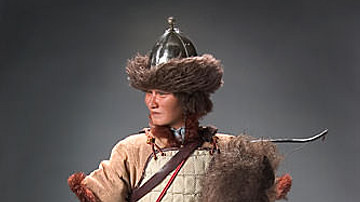
Attila the Hun (r. 434-453 CE) was the leader of the ancient nomadic people known as the Huns and ruler of the Hunnic Empire, which he established. His name means "Little Father" and, according to some historians, may not have...
