
Search
Remove Ads
Advertisement
Search Results

Definition
Pythagoras
Pythagoras (l.c. 571 to c. 497 BCE) was a Greek philosopher whose teachings emphasized the immortality and transmigration of the soul (reincarnation), virtuous, humane behavior toward all living things, and the concept of "number"...

Definition
Semiramis
Semiramis is a legendary queen thought to based on the historical Sammu-Ramat (r. 811-806 BCE) the queen regent of the Assyrian Empire who held the throne for her young son Adad Nirari III until he reached maturity. She is also known...

Definition
Moses
Moses (c. 1400 BCE) is considered one of the most important religious leaders in world history. He is claimed by the religions of Judaism, Christianity, Islam, and Bahai as an important prophet of God and the founder of monotheistic belief...

Definition
Tushpa
Tushpa, later known as Van, was the capital of the Urartu kingdom of ancient Armenia, eastern Turkey, and western Iran from the 9th to 6th century BCE. Located on the eastern shore of Lake Van in modern Turkey, the city was a fortress...
Definition
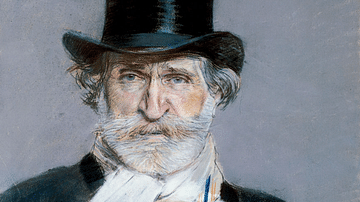
Giuseppe Verdi
Giuseppe Verdi (1813-1901) was an Italian composer best known for operas such as Rigoletto, La traviata, and Aida. Verdi is noted for his powerful scores and strong characters where anti-heroes lead the dramatic action through...
Definition
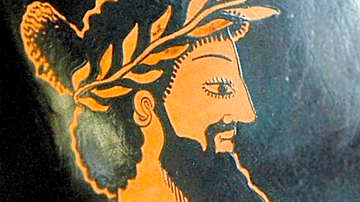
Croesus
Croesus (r. 560-546 BCE) was the King of Lydia, a region in western Asia Minor (modern-day Turkey) and was so wealthy that the expression "as rich as Croesus" originates in reference to him. Best known for his wealth, he is also famous...

Definition
Akkad and the Akkadian Empire - The First Multinational Empire in the World
The city of Akkad was the seat of the Akkadian Empire (2350/2334-2154 BCE), the first multinational political entity in the world, founded by Sargon the Great, who unified Mesopotamia...

Definition
Minoan Art
The art of the Minoan civilization of Bronze Age Crete (2000-1500 BCE) displays a love of animal, sea, and plant life, which was used to decorate frescoes and pottery and also inspired forms in jewellery, stone vessels, and sculpture...

Definition
New Testament
New Testament is the name for the second half of the Christian Bible, compiled from the 2nd century CE, after the separation of Christianity from Judaism. The Christian Bible retained books of the Jewish scriptures, the Old Testament...

Definition
Ancient Persia
Persia (roughly modern-day Iran) is among the oldest inhabited regions in the world. Archaeological sites in the country have established human habitation dating back 100,000 years to the Paleolithic Age with semi-permanent settlements...
