
Search
Remove Ads
Advertisement
Search Results

Image
A Pair of Lions from Tell Harmal at the Iraq Museum
Two terracotta lions found at the entrance to the Dagan Temple at Tell Harmal (ancient Shaduppum), in the eastern outskirt of Baghdad, Old Babylonian period, c. 1800 BCE. The temple was a typical Old-Babylonian...

Image
Mesopotamian Tablet on Marduk
Babylonian tablet, a scholar speculating on how powerful, independent Mesopotamian gods can be seen as aspects of the god Marduk. From Babylon, Southern Mesopotamia, Iraq. Neo-Babylonian Period, reign of Nebuchadnezzar...
Image
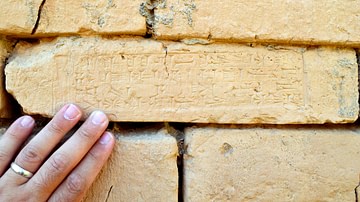
Inscribed Brick at the Processional Way of Babylon
This is an original brick in of the walls of the processional way (or street) at the ancient city of Babylon, in modern-day Iraq. The name of the builder (the neo-Babylonian king Nebuchadnezzar II...
Image
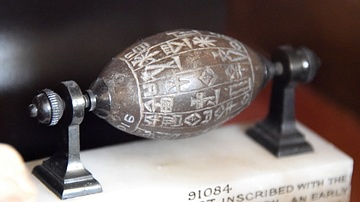
Macehead with the Name of Anum-mutabil
This oval stone mace-head was inscribed with the name of Anum-mutabil (formerly read as Ilum-muttabbil), governor of the Babylonian city Dur-ilu. The cuneiform inscription reads "Ilum-muttabbil, mighty man, favorite...
Image
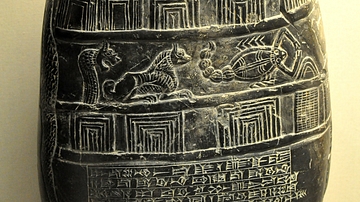
Boundary Stone from Mesopotamia
This boundary stone, or kudurru, records a gift of land made by Eanna-shum-iddina, governor of the Sea-Land in Southern Babylonia. The receiver's name is Gula-Eresh. The text ends with a series of curses on anyone...
Image
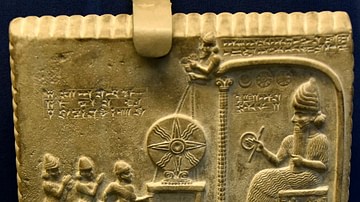
The Sun God Tablet or the Tablet of Shamash from Sippar
The Sun God tablet from the Temple of Shamash at Sippar, Southern Mesopotamia modern-day Iraq, Middle Babylonian Period, 860-850 BCE. The upper part of the tablet has a carved panel. Nabu-nadin-shum...

Image
Map of the Median Hegemony, c. 600 BCE - Power, Influence & Transition in Western Asia after Assyria
The Median hegemony (late 7th-early 6th century BCE) emerged in the aftermath of the Bronze Age Collapse (c. 1200-1150 BCE) and, more directly, the disintegration...
Image
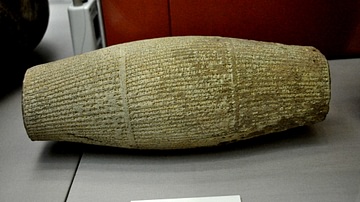
Terracotta Clay Cylinder of King Nebuchadnezzar II
The three columns of cuneiform inscriptions on this cylinder mention the building and reconstruction of various shrines, quays, gates, and processional boats by king Nebuchadnezzar II at Babylon for...
Image
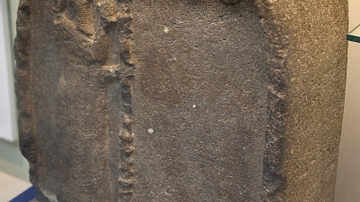
Stela of Nabonidus
Here, Nabonidus (reigned 556-539 BCE) wears the traditional dress of a Babylonian king, holding objects symbolizing justice and power. Before him are the star of Ishtar, the winged-disc of Shamash, and the crescent moon god...

Collection
Kingdoms & Empires of Ancient Mesopotamia
The region of ancient Mesopotamia was home to several key kingdoms and empires that left a lasting impact on the region and influenced future civilizations. One of the earliest empires was the Akkadian Empire...
