
Search
Remove Ads
Advertisement
Search Results

Definition
Ezekiel
Ezekiel was both a priest and a prophet who lived in the 6th century BCE. The prophets of Israel were oracles (a term for a person as well as a place) for ways in which humans communicated with their gods. The oracle was possessed by...

Definition
Nabu - The Babylonian God of Wisdom and Writing
Nabu (sometimes known as Tutu) was the Babylonian god of wisdom, learning, prophecy, scribes, and writing, also responsible for the abundant harvest and all growing things. His name means "the Announcer,"...

Definition
Ten Commandments
The Ten Commandments introduce the legislation received by Moses on Mt. Sinai after the Israelites escaped from Egypt (as related in the biblical book of Exodus). The "ten commandments" is often used as shorthand for the basic...

Definition
Enlil - Mesopotamian Keeper of the Tablets of Destiny
Enlil (also known as Ellil and Nunamnir) was the Sumerian god of the air in the Mesopotamian pantheon, but he was more powerful than any other elemental deity and eventually was worshiped as King of...

Definition
Gezer
Gezer is an ancient city and archaeological site located in central Israel where the central mountains meet the northern Shephelah, about 10 km southeast of the city of Ramleh. According to the Hebrew Bible, Gezer was one of the great...

Definition
Jeremiah
Jeremiah (c. 650-570 BCE) was a major prophet of Israel in the Hebrew Bible. In addition to his book of prophecy, he is also credited with writing the Books of Kings and Lamentations (perhaps written by his scribe, Baruch). Called to...

Article
Herodotus on Babylon
The description of Babylon and Babylonian customs in Histories by the Greek historian Herodotus (l. c. 484-425/413 BCE) has long been challenged for accuracy and been found wanting, leading some scholars to dismiss the work...

Interview
Interview: King of the World by Matt Waters
In this interview, World History Encyclopedia sits down with author Matt Waters to chat about his new book King of the World: The Life of Cyrus the Great published by Oxford University Press. Kelly: Can...

Definition
Tiglath Pileser I
Tiglath Pileser I (reigned 1115-1076 BCE), an Assyrian king of the period known as the Middle Empire, revitalized the economy and the military that had been suffering, more or less, since the death of the king Tukulti Ninurta...
Definition
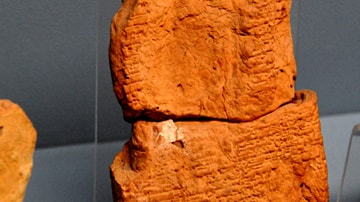
Code of Ur-Nammu - The Oldest Law Code in the World
The Code of Ur-Nammu (circa 2100-2050 BCE) is the oldest extant law code in the world. It was written by the Sumerian king Ur-Nammu (reign circa 2112-2094 BCE) or his son Shulgi of Ur (reign 2094 to...
