
Search
Remove Ads
Advertisement
Search Results

Article
Poor Man of Nippur - What Does One Deserve?
The Poor Man of Nippur (circa 701 BCE) is a Babylonian poem on the themes of the obligations of hospitality and revenge for an undeserved injury. A poor man of the city of Nippur feels mistreated when he visits...

Article
Herodotus on Babylon
The description of Babylon and Babylonian customs in Histories by the Greek historian Herodotus (l. c. 484-425/413 BCE) has long been challenged for accuracy and been found wanting, leading some scholars to dismiss the work...

Interview
Interview: King of the World by Matt Waters
In this interview, World History Encyclopedia sits down with author Matt Waters to chat about his new book King of the World: The Life of Cyrus the Great published by Oxford University Press. Kelly: Can...

Article
Roman Women in Business
Roman women faced legal, ideological, and cultural limitations in several areas of their lives; deep-rooted traditions regarding the role of women in the Roman world resulted in pre-conceived views which saw women characterised...

Teaching Bundle
Ancient Rome Teaching Resource Bundle
This Ancient Rome Teaching Resource Bundle is a collection of teaching resources that can be downloaded for free – no registration required. Our teaching resources and lesson plans are adapted to students'...

Article
Mesopotamian Effects on Israel During the Iron Age
The Iron Age in the traditional Ancient Near Eastern chronology ranges from somewhere around 1200 BCE to 333 BCE. It begins from the era when it was first thought iron came to be used up to the ascendency...

Article
Ancient Egyptian Agriculture
Agriculture was the foundation of the ancient Egyptian economy and vital to the lives of the people of the land. Agricultural practices began in the Delta Region of northern Egypt and the fertile basin known as the Faiyum...
Article
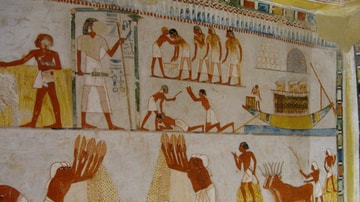
Jobs in Ancient Egypt
In ancient Egypt, the people sustained the government and the government reciprocated. Egypt had no cash economy until the coming of the Persians in 525 BCE. The people worked the land, the government collected the bounty...

Worksheet/Activity
Trade in the Roman Empire - Web Quest & Map Skills
This activity has been designed to fit a 20-30-minute slot for your class and is suitable for both online and classroom teaching. Students have to do a web quest in order to complete a map. It is...

Definition
Mesopotamian Government - Helping and Serving the Gods
Ancient Mesopotamian government was based on the understanding that human beings were created to help and serve the gods. The high priest, king, assembly of elders, governors, and any other officials...
