
Search
Remove Ads
Advertisement
Search Results

Image
Neo-Assyrian Political Pact Stele, Al-Anbar
Only this fragment of a large stele has survived. On the surface, the Assyrian and Babylonian kings were carved in relief. The cuneiform inscription narrates a political treaty between them. The faces of...

Definition
Sargon of Akkad - From Gardener to King of the Four Corners of the World
Sargon of Akkad (reign 2334-2279 BCE) was the king of the Akkadian Empire of Mesopotamia, the first multinational empire in history, who united the disparate kingdoms of the region under...
Definition
Susa
Susa was one of the oldest cities in the world and part of the site is still inhabited as Shush, Khuzestan Province, Iran. Excavations have uncovered evidence of continual habitation dating back to 4395 BCE but that early community grew...
Image
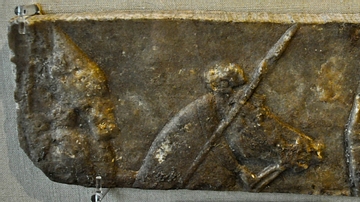
Assyrian Cavalrymen
A fragment of an alabaster bas-relief which depicts Assyrian cavalrymen (in a war scene?). From Kuyunjik (modern-day Ninawa Governorate, Iraq). Neo-Assyrian period, reign of Ashurbanipal, 668-627 BCE. The Burrell Collection...
Image
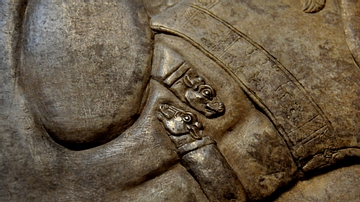
Assyrian Armlet
A close-up view of the right arm of a human-headed and winged protective spirit, Apkallu (or Sage). There is an armlet which embraces the right biceps muscle. The armlet's ends are sheep-headed. Note the decorations on the lower...
Image
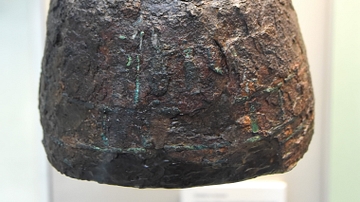
Assyrian Helmet
Assyrian military equipment was particularly effective. Pointed helmets deflected blows or missiles, and were commonly issued to Assyrian soldiers. This iron example was decorated with bronze inlay, now corroded to a greenish...

Image
Assyrian Slingers Attacking The City of Lachish
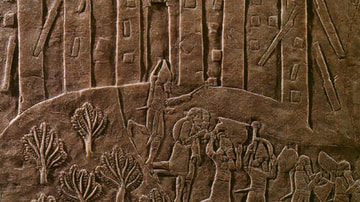
This is a fragment of a wall relief which shows Assyrian slingers in action. The four men appear to launch small round stones into the air, aiming at the enemy troops who stand at the top of the city walls...
Image
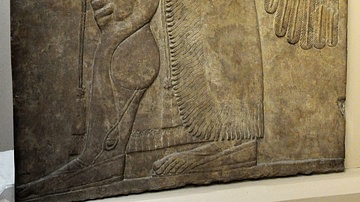
An Assyrian Apkallu Carrying a Goat
This alabaster bas-relief depicts a human-headed and winged man, Apkallu or Sage, carrying a goat. He wears a sandal carries a goat with his left arm and what appears to be a palm branch in his right hand. Note...
Image
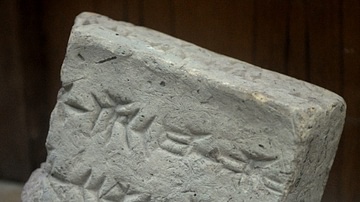
Assyrian Cuneiform Brick
The cuneiform inscriptions on this mud-brick mention the name of Ashurnasirpal II, the Assyrian king. From northern Mesopotamia, modern-day Iraq. Neo-Assyrian period, reign of Ashurnasirpal II, 883-859 BCE. The Sulaymaniyah...
Image
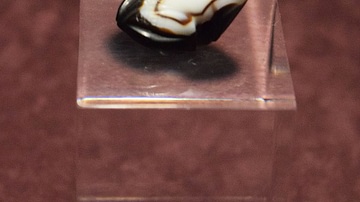
Assyrian Frog-Shaped Weight
This Assyrian frog-shaped weight dates from the 16th-15th century BCE and is made of sardonyx. It has a Middle Assyrian cuneiform inscription along the frog's back. (Metsamor Historical-Archaeological Museum-Reserve...
