
Search
Remove Ads
Advertisement
Search Results
Image
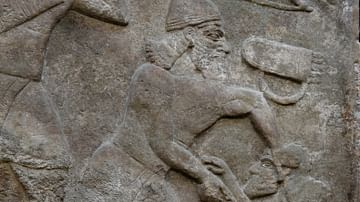
Assyrian Soldier Kills His Enemy
Alabaster bas-relief showing an Assytian soldier killing his enemy. Neo-Assyrian Period, 865-860 BCE. Detail of Panel 8 (top), Room B, the North-Palace Palace, Nimrud, modern-day Iraq. (The British Museum, London)
Image
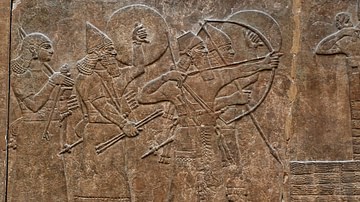
Assyrian Siege
This Assyrian relief from the North-West Palace in Kalhu (c. 865-860 BCE) shows King Ashurnasirpal advancing on an enemy city, protected by a shield-bearer. Ahead is a wheeled siege engine, which carries more archers and contains...
Image
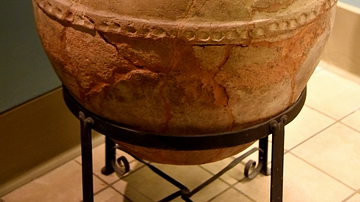
Assyrian Storage Jar
This jar was found in one of the wine-cellars in the arsenal at Nimrud (ancient Kalhu). It is marked in cuneiform with its capacity; 1 homer, 3 seah, 7 qa. In fact, it holds about 300 liters. Assyrian, late 7th century BCE...
Image
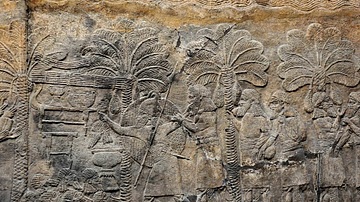
Assyrian Military Campaign in Southern Iraq
This wall panel was part of a large alabaster wall relief. The Assyrian king in a chariot (who is noy shown) watches as prisoners are brought in, and heads and booty are piled-up in a palm grove. In Assyrian...

Image
Assyrian Military Campaign in Southern Iraq
This wall panel was part of large alabaster wall relief. The whole scene includes a central band of river, the Tigris or Euphrates, that separates two otherwise independent compositions in which the Assyrians...

Image
Assyrian Bracelet
A close-up image of a rosette-type bracelet. This is part of a large alabaster bas-relief which depicts an eagle-headed and winged protective spirit, Apkallu or Sage. The rosette lies at the ventral surface of the left wrist...
Image
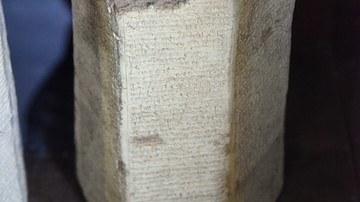
Assyrian Prism of Esarhaddon
Hexagonal clay prism with cuneiform inscription narrating the military campaigns of the Assyrian king Esarhaddon (r. 680-669 BCE). Later on, the upper aspect was used a candle holder by the owner. Probably from Nineveh...

Article
Battles & Conquests Of The Ottoman Empire (1299-1683)
Spanning across three continents and holding dominance over the Black and Mediterranean Seas, the Ottoman Sultanate (1299-1922) was a global military superpower between the 15th and 17th centuries...

Definition
Nebuchadnezzar II
Nebuchadnezzar II (r. 605/604-562 BCE) was the greatest King of ancient Babylon during the period of the Neo-Babylonian Empire (626-539 BCE), succeeding its founder, his father, Nabopolassar (r. 626-605 BCE). He is best known...

Definition
Ninurta - The Sumerian Hero-God of War
Ninurta (identified with Ningirsu, Pabilsag, and the biblical Nimrod) is the Sumerian and Akkadian hero-god of war, hunting, and the south wind. He first appears in texts in the early 3rd millennium BCE as an...
