
Search
Remove Ads
Advertisement
Search Results

Definition
Pergamon
Pergamon (also Pergamum) was a major intellectual and cultural center in Mysia (northwest Asia Minor, modern-day Turkey) which flourished under the Attalid Dynasty (281-133 BCE) during the Hellenistic Period. It was the capital of the...

Definition
Anahita
Anahita is the ancient Persian goddess of fertility, water, health and healing, and wisdom. Owing to her association with life-giving properties, she also came to be connected with ancient Persian warfare as soldiers would pray to her...

Definition
Muhammad Ghori
Shihab al-Din (also Muʿizz al-Din Muhammad ibn Sam), popularly known as Muhammad Ghori (r. 1173-1206 CE), was the Muslim ruler who laid the foundation for the subsequent Islamic ruling dynasties of India which saw its pinnacle...

Definition
Fire Temple
Fire Temples are places of worship in the Zoroastrian religion. They were known as ataskada (“house of fire”) by the Persians but are best known today by their Greek name pyratheia (fire temple). They are thought to have originated...

Definition
Jesus Christ
Jesus Christ is the designation of Jesus of Nazareth (d. c. 30 CE), who was an itinerant Jewish prophet from Galilee in northern Israel. He preached the imminent intervention in human affairs by the God of the Jews, when God would...
Definition
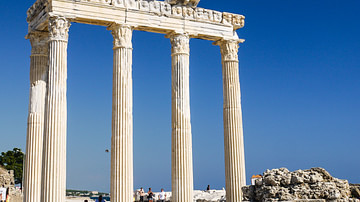
Side
Side (pronounced see-day) was a city on the southern coast of Cilicia (modern-day Turkey) first settled in the 7th century BCE by immigrants from Cyme, an Aeolian municipality to the north near the kingdom of Lydia. Its name means 'pomegranate'...

Definition
Urartu Religion
The religion of the Urartu civilization, which flourished principally in ancient Armenia from the 9th to 6th century BCE, was a unique mix of indigenous, Hurrian and Mesopotamian gods and symbolism. The pantheon was headed by...

Definition
Moabite Stone [Mesha Stele]
The Moabite Stone, otherwise known as the Mesha Stele, contains an ancient inscription by Mesha, King of Moab during the late 9th century BCE, elements of which match events in the Hebrew Bible. The inscription describes...

Definition
The Kingdom of Kush
Kush was a kingdom in northern Africa in the region corresponding to modern-day Sudan. The larger region around Kush (later referred to as Nubia) was inhabited c. 8,000 BCE but the Kingdom of Kush rose much later. The Kerma...

Article
Ten Ancient Rome Facts You Need to Know
Ancient Roman culture affected vast numbers of people across the known world of its time, beginning with the rise of the Roman Republic (509-27 BCE) and throughout the duration of the Roman Empire (27 BCE -...
