
Search
Remove Ads
Advertisement
Search Results

Article
Sassanian Kings List & Commentary
The Sassanian Empire (224-651) was the greatest expression of Persian culture in the ancient world. It was consciously modeled on the earlier Achaemenid Empire (c. 550-330 BCE) which established Persian supremacy...

Definition
Despotate of Epirus
The Despotate of Epirus was one of the successor states of the Byzantine Empire when it disintegrated following the Fourth Crusade's capture of Constantinople in 1204 CE. It was originally the most successful of those successor...

Definition
Palestine - The Ancient Land of Canaan
In the ancient world, Palestine was part of the region known as Canaan, where the Kingdoms of Israel and Judah were located. The term "Philistia" (from which "Palestine" comes) initially referred to an area of...

Definition
Babylon - The Gate of the Gods
Babylon is the most famous city from ancient Mesopotamia, whose ruins lie in modern-day Hillah, Iraq, 59 miles (94 km) southwest of Baghdad. The name is derived from bav-il or bav-ilim, which in Akkadian meant "Gate...

Article
Trade in the Byzantine Empire
Trade and commerce were essential components of the success and expansion of the Byzantine Empire. Trade was carried out by ship over vast distances, although for safety, most sailing vessels were restricted to the...

Article
Enheduanna - Poet, Priestess, Empire Builder - Redefining the Gods for the People
Enheduanna (circa 2300 BCE) is the world's first author and was the daughter (either literally or figuratively) of the great empire-builder Sargon of Akkad (reign 2334-2279 BCE...

Article
The Roman Empire in West Africa
At its fullest extent, the Roman Empire stretched from around modern-day Aswan, Egypt at its southernmost point to Great Britain in the north but the influence of the Roman Empire went far beyond even the borders of...
Image
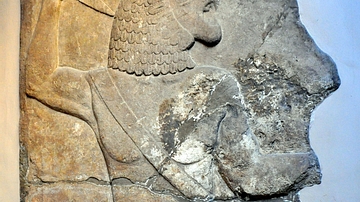
Assyrian Ugallu
This gypsum wall relief depicts a standing lion-headed man holding a dagger, looking to the right. This is "the Great Lion" or "Ugallu". Layard found it in two fragments, among the so-called "Gallery XLIX (O); the long gallery"...
Image
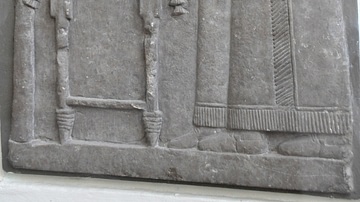
Assyrian Royal Horse Bridle
This gypsum wall panel depicts two female courtiers in front of a table, on which the royal horse bridle has been placed. Neo-Assyrian Period, reign of Ashurbanipal II, 660-650 BCE. From the North Palace at Nineveh, Mesopotamia...
Image
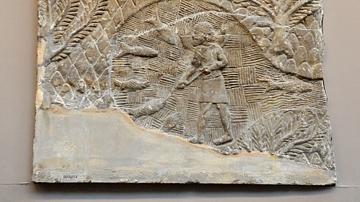
Assyrian Fisherman
This alabaster bas-relief depicts a man fishing in a mountain pool or pond. Neo-Assyrian Period, reign of Sennacherib, 700-692 BCE. From Room XLIV (LL) of the South-West Palace at Nineveh (Kouyunjik), Mesopotamia, modern-day...
