
Search
Remove Ads
Advertisement
Search Results

Article
Baroque, Age of Contrasts - Exhibition Interview Schweizerisches Landesmuseum
The Baroque era, which lasted from roughly 1580 and 1780, was a time of enormous contrasts: Opulence and innovation, on the one hand; death and crises, on the other. Ongoing religious...

Definition
Teishebaini
Teishebaini (aka Tesebaini, modern Karmir-Blur, near Yerevan, Armenia) was an important fortress city of the Urartu civilization and excavations at the site, largely undisturbed since its abandonment c. 590 BCE, have provided an invaluable...

Definition
Warfare - The Development of Resources for Armed Conflict
Warfare is generally understood to be the controlled and systematic waging of armed conflict between sovereign nations or states, using military might and strategy, until one opponent is defeated...
Image
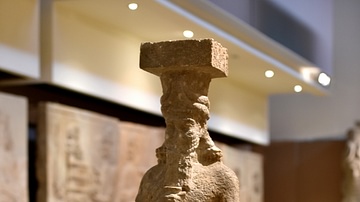
Statue of a Minor Deity from Khorsabad
This statue of a minor deity (probably Ea, god of water and sea) stands and holds a vessel in his hands, from which water flows. It is one of a pair of statues which were found outside the entrance (in front...

Image
Apkallu from Khorsabad
This alabaster bas-relief is probably part of a long religious ritual scene. The beaded male figure on the left has two pairs of wings and holds a pine cone in his right hand while the left hand holds a bucket. He wears a...

Definition
Amber in Antiquity
Amber, the fossilised resin of trees, was used throughout the ancient world for jewellery and decorative objects. The main source was the Baltic region where amber, known to mineralogists as succinite, was washed up onto beaches...

Image
Circular Stone Vessel From Tarbisu
A fragment of a circular stone vessel which was dedicated to the temple of God Nergal by a high official. The carved scenes in low relief depict the Assyrian king Shalmaneser III on his knees before a central object...

Article
Trade in Ancient Mesopotamia - How Commerce Encouraged Civilization
Local trade in ancient Mesopotamia began in the Ubaid period (circa 6500-4000 BCE), had developed into long-distance trade by the Uruk period (circa 4000-3100 BCE), and was flourishing by...
Image
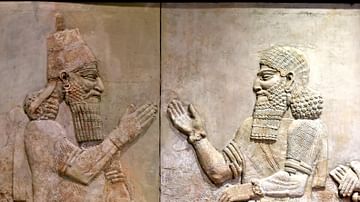
Sargon II and Turtanu
This almost 3 meters high alabaster bas-relief depicts the Assyrian king Sargon II (left; wearing the typical conical hat). Recognizable by the long sword hanging on his side, diadem, long curly beard, and the elegant dress...
Image
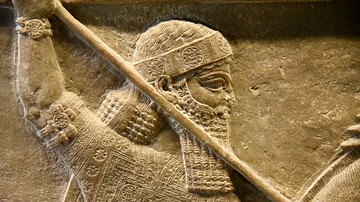
Ashurbanipal II
This is a detail of a large wall relief of the so-called Assyrian lion-hunting scenes. This is the Assyrian King Ashurbanipal II. The King holds a long spear and is about to thrust it into a rearing lion's mouth (not shown here...
