
Search
Remove Ads
Advertisement
Search Results

Definition
Puritans
The Puritans were English Protestant Christians, primarily active in the 16th-18th centuries CE, who claimed the Anglican Church had not distanced itself sufficiently from Catholicism and sought to 'purify' it of Catholic practices...

Definition
Peter the Great
Peter I of Russia (Peter the Great) was the Tsar of Russia from 1682-1721 and Emperor of Russia from 1721-1725. During his long reign, Peter had absolute power and brought real change to Russia, including building its first navy...

Definition
Empress Theodora
Theodora reigned as empress of the Byzantine Empire alongside her husband, Emperor Justinian I, from 527 CE until her death in 548 CE. Rising from a humble background and overcoming the prejudices of her somewhat disreputable...

Definition
Robert Hooke
Robert Hooke (1635-1703) was an English scientist, architect, and natural philosopher who became a key figure in the Scientific Revolution. Hooke conducted his scientific experiments outside the auspices of universities, and he was...

Definition
Bartolomé de Las Casas
Bartolomé de Las Casas (1484-1566) was a Spanish Dominican friar and former conquistador who revealed the atrocities of the conquests of New Spain and Peru and who strove to protect the basic rights of indigenous peoples...
Definition
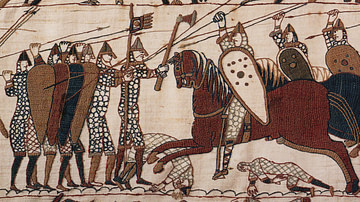
Anglo-Saxon Warfare
Anglo-Saxon warfare was characterised by frequent and violent conflicts between petty kings, which ultimately led to the rise of larger kingdoms such as the Kingdom of Mercia, the Kingdom of Northumbria, and the Kingdom of...
Definition
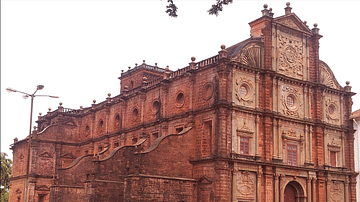
Portuguese Goa
Goa, located on the west coast of India, was a Portuguese colony from 1510 to 1961. The small coastal area was conquered by Afonso de Albuquerque (c. 1453-1515) and became an important trade hub for the Eastern spice trade. Goa...

Definition
Byzantine Art
Byzantine art (4th - 15th century CE) is generally characterised by a move away from the naturalism of the Classical tradition towards the more abstract and universal, there is a definite preference for two-dimensional representations...

Definition
Charles I of England
Charles I of England (r. 1625-1649) was a Stuart king who, like his father James I of England (r. 1603-1625), viewed himself as a monarch with absolute power and a divine right to rule. His lack of compromise with Parliament...

Definition
Mary I of England
Mary I of England reigned as queen from 1553 to 1558. The eldest daughter of Henry VIII of England (r. 1509-1547) with Catherine of Aragon (1485-1536), she restored Catholicism in England while her persecution of Protestants...
