
Search
Did you mean: Arapaho?
Remove Ads
Advertisement
Search Results
Image
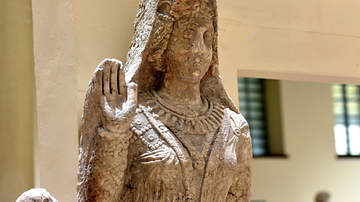
Princess Doshafri from Hatra
This is the upper part of the statue of princess "Doshafri", daughter of king Sanatruq I of Hatra (reigned c. 140 - 180 CE). Although the statue is somewhat weathered, it is an excellent example conveying the appearance...
Image
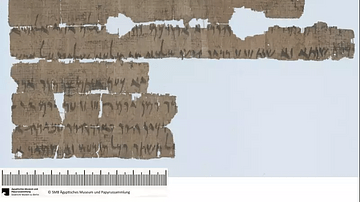
The Passover Papyrus from Elephantine
A papyrus letter, written in Aramaic, from the fortified island of Elephantine in Egypt. The letter was written c. 419 BCE by a Jewish man named Hananiah and is addressed to his brother Jedoniah and the rest of...
Image
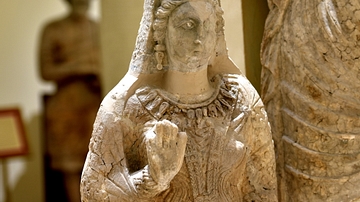
Statue of Princess Simi from Hatra
This is the upper part of the statue of Princess "Simi". Simi was the daughter of princess Doshafri, and granddaughter of king Sanatruq I (reigned c. 140 - 180 CE) through her mother. The overall depiction of the...
Image
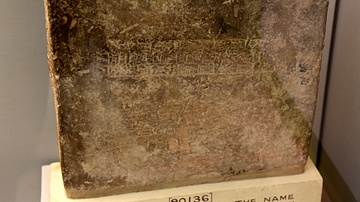
Brick Stamped with the Name of Nebuchadnezzar II
King Nebuchadnezzar II's building program at Babylon used around 15,000,000 baked bricks. Thousands bore his name and titles stamped into the clay: "Nebuchadnezzar...the eldest son of Nabopolassar, King...
Image
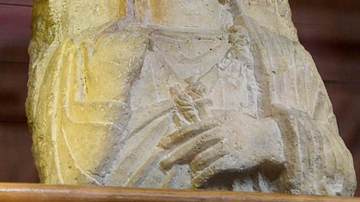
Bust of a Woman from Palmyra
The Aramaic inscription on this limestone bust of a woman reads "Attai daughter of El'a". The woman wears a Greek chiton, From a funerary relief at Palmyra, modern-day Homs Governorate, Syria. Circa 50-150 CE. (The British...
Image
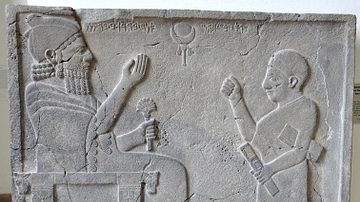
Prince Barrakib
This basalt wall relief depicts Prince Barrakib (Bar-Kib) sitting on a throne. Before him, a scribe stands with a writing tablet beneath his arm. The Aramaic inscription besides his head reads "I'm Barrakib, son of Panammwua"...
Image
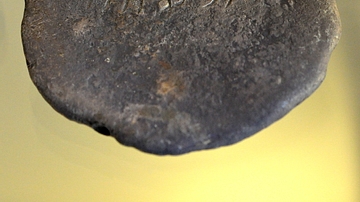
Silver from Sam'al
This rounded piece of silver (which is part of a hack silver) was used as a method of payment. Its weigh is 497.38 g. The overlying Aramaic inscription mentions that this is a property of Barrakib, son of Panammuwa, Prince of...

Image
Medieval Jewish Tombstones in Yeghegis, Armenia
No historical evidence exists of a Jewish community in Yeghegis, Armenia during medieval times. Indeed, there is also no written record of contemporaneous Jewish communities in medieval Armenia. Nearly...
Image
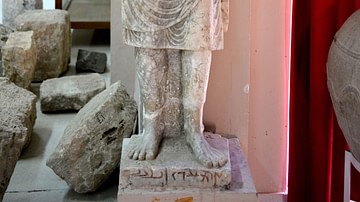
Statue of Priest Bano Abdo from Hatra
Statue of the priest Bano Abdo from Hatra. The statue’s base is inscribed with an Aramaic text. The man has a long beard and an upward-curling mustache. He looks forward and wears a long conical hat. His hands...

Image
Jewish Tombstones in Yeghegis, Armenia
No historical evidence exists of a Jewish community in Yeghegis, Armenia during medieval times. Indeed, there is also no written record of contemporaneous Jewish communities in medieval Armenia. Nearly 40 tombstones...
