
Search
Did you mean: Arapaho?
Remove Ads
Advertisement
Search Results

Article
Colchis & Iberia in Antiquity
Colchis (western Georgia) and Kartli/Iberia (eastern and southern Georgia) were important regions in the Caucasus area of Eurasia from the Bronze Age of the 15th century BCE. Prospering through agriculture and trade...

Article
Hildegard of Bingen's Unknown Language and Unknown Letters
Sometime in 1153 or 1154, the German nun Hildegard of Bingen (1098-1179) wrote a letter to the elderly Pope Anastasius IV (1073-1154). Her words were scathing. She called the pope tired and criticized...

Article
Women in the New Testament
Women in the New Testament are presented for the most part along the contours of both Jewish and Greco-Roman concepts of the social construction of gender roles. Women’s value to society was in their role in procreation...

Article
Origins of Christian Antisemitism in the Gospels
Antisemitism is a modern term that describes prejudice and hostility to Jews and Judaism. The term is derived from the later social scientific categorization of the subfamily of the Afro-Asiatic languages...

Article
Historical Problems in the Trial(s) & Crucifixion in the Gospels
The story of the trial and crucifixion of Jesus Christ is reenacted every year by Christians all over the world in the Easter liturgy. The story has become an essential article of faith and...

Interview
Interview: King of the World by Matt Waters
In this interview, World History Encyclopedia sits down with author Matt Waters to chat about his new book King of the World: The Life of Cyrus the Great published by Oxford University Press. Kelly: Can...
Image
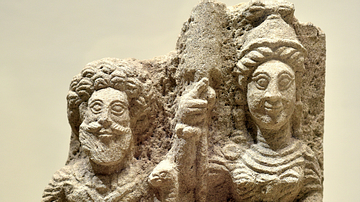
Goddess Al-Lat and an Elderly God from Hatra
This limestone slab carved in relief shows two deities. On the right, the goddess Al-Lat is depicted, she wears a military dress and helmet and holds a spear in her right hand and a shield in her left arm...
Image
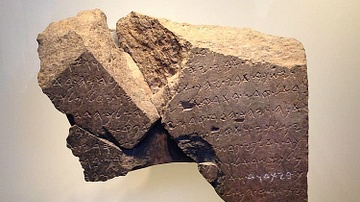
Tel Dan Inscription
Erected in the mid ninth-eigth century B.C.E., the Tel Dan Stela includes the Tel Dan Inscription (or "House of David" inscription) thereby providing the first historical evidence of King David from the Bible. The inscription...
Image
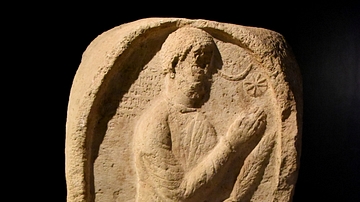
Parthian Stele from Ashur
The Aramaic inscription says that this stele was erected in the 324th year of the Seleucid calendar (12-13 CE) by Sanashu's son, Re'n-tayar, the esteemed shepherd, for the goddess Sherua. Parthian, first century CE. From...
Image
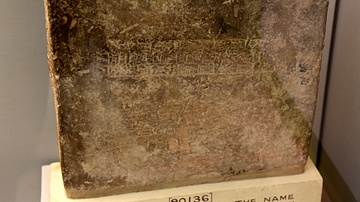
Brick Stamped with the Name of Nebuchadnezzar II
King Nebuchadnezzar II's building program at Babylon used around 15,000,000 baked bricks. Thousands bore his name and titles stamped into the clay: "Nebuchadnezzar...the eldest son of Nabopolassar, King...
