
Search
Remove Ads
Advertisement
Search Results

Article
Song of Everlasting Sorrow
The Song of Everlasting Sorrow is a narrative poem of the Tang Dynasty (618-907 CE) inspired by the love affair between Xuanzong (r. 712-756 CE), the seventh emperor of the dynasty, and his consort Lady Yang. It was written...

Article
Mongol Multiculturalism
The Mongol Empire accepted and promoted many other cultures. Historians often talk about cultural exchange across Asia in the Mongol Empire as something that was just facilitated by peace and stability across such a huge...

Article
Kingdom of Magadha: Wars and Warfare
In ancient India from the 6th century BCE onwards, the kingdom of Magadha (6th century BCE to 4th century BCE) made a mark for itself. Located in the eastern part of India in what is today the state of Bihar, it...

Definition
Seleucid Empire
The Seleucid Empire (312-63 BCE) was the vast political entity established by Seleucus I Nicator ("Victor" or "Unconquered", l. c. 358-281 BCE, r. 305-281 BCE), one of the generals of Alexander the Great who claimed a part of...
Definition
Artashat
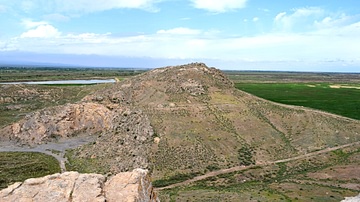
Artashat (aka Artaxata) was the capital of Ancient Armenia from 176 BCE and remained so for over 300 years of the kingdom's history. Located just south of Armenia's modern capital Yerevan, according to the ancient historian Plutarch...

Image
Shang Dynasty Bronze Zun
A bronze vessel (zun) with the form of a double-ram. Shang Dynasty, 1200-1050 BCE, China. (British Museum, London)

Image
Figure of a Mongol, Yuan Dynasty
A detail of a burnished earthenware figurine of a Mongol. Yuan Dynasty, 14th century CE. H. 11 7/16 in. (29 cm); W. 4 7/16 in. (11.3 cm); D. 3 3/8 in. (8.6 cm). (Metropolitan Museum of Art, New York)

Image
Qin Dynasty Crossbow
A Qin dynasty crossbow (221-207 BCE). From Beiguan, Xian, China.
Image
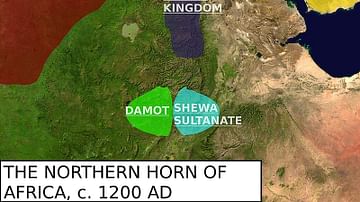
Map of the Zagwe Dynasty
Map featuring the approximate boundaries of the Zagwe Dynasty and its most prominent neighbours around the beginning of the 13th century.
Image
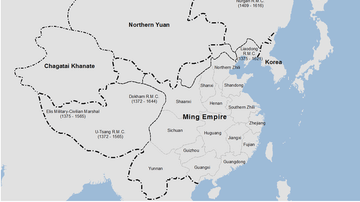
Ming Dynasty Empire, c. 1409 CE
The Ming Dynasty Empire (1368-1644 CE) at the time of the Yongle Emperor (aka Chengzu r. 1403-1424 CE).
