
Search
Remove Ads
Advertisement
Search Results

Article
Monotheism in the Ancient World
Monotheism is simply defined as the belief in one god and is usually positioned as the polar opposite of polytheism, the belief in many gods. However, the word monotheism is a relatively modern one that was coined in the mid-17th century...

Article
A Visual Glossary of Classical Architecture
Abacus - a large slab placed above the column capital to support the architrave or an arch placed above it. Akroterion - a decorative piece added to the roof of a temple at the apex and corners, usually made of clay or bronze and often in...
Article
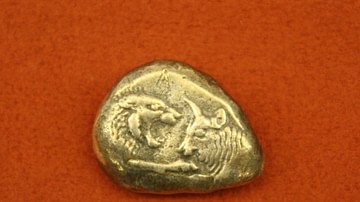
The Importance of the Lydian Stater as the World's First Coin
The Lydian Stater was the official coin of the Lydian Empire, introduced before the kingdom fell to the Persian Empire. The earliest staters are believed to date to around the second half of the 7th century BCE, during the reign of King Alyattes...

Article
The Olive in the Ancient Mediterranean
Olives and olive oil were not only an important component of the ancient Mediterranean diet but also one of the most successful industries in antiquity. Cultivation of the olive spread with Phoenician and Greek colonization from Asia Minor...
Article
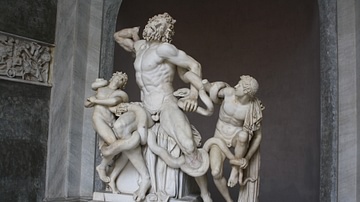
Laocoön: The Suffering of a Trojan Priest & Its Afterlife
The sculpture group of Laocoön and His Sons, on display in the Vatican since its rediscovery in 1506, depicts the suffering of the Trojan prince and priest Laocoön (brother of Anchises) and his young sons Antiphantes and Thymbraeus and is...

Article
Plato: The Name and The Poet
Plato (l. c. 424/423 to 348/347 BCE), the Greek philosopher whose works have significantly shaped Western thought and religion, is said to have initially been a poet and playwright and, even if the primary source of this claim (the often...

Article
Pericles & the Restoration of the Athenian Agora
The agora of Athens developed from the 6th century BCE until it was destroyed in the Persian invasion of 480 BCE. Afterwards, the statesman Pericles (l. 495-429 BCE) used funds from the Delian League to restore it as the physical manifestation...

Article
The Delian League, Part 2: From Eurymedon to the Thirty Years Peace (465/4-445/4 BCE)
This text is part of an article series on the Delian League. The second phase of the Delian League's operations begins with the Hellenic victory over Mede forces at Eurymedon and ends with the Thirty Years Peace between Athens and Sparta...

Article
Pherenike the Female Olympic Trainer
Pherenike (l. c. 388 BCE, also known as Kallipateira) was an athlete from Rhodes who, because she was a woman, could not compete in the Olympic Games and, as a married woman, was not allowed to even watch them. Defying these rules and risking...

Article
Cycladic Sculpture
The Cycladic islands of the Aegean were first inhabited by voyagers from Asia Minor around 3000 BCE and a certain prosperity was achieved thanks to the wealth of natural resources on the islands such as gold, silver, copper, obsidian and...
