
Search
Did you mean: Amenhotep III?
Remove Ads
Advertisement
Search Results

Definition
Canaan
Canaan was the name of a large and prosperous ancient country (at times independent, at others a tributary to Egypt) located in the Levant region of present-day Lebanon, Syria, Jordan, and Israel. It was also known as Phoenicia. The origin...

Article
The Egyptian Amulet: Pious Symbols of Spiritual Life
Material Objects & Cultures Material objects convey volumes about the people who possessed them. Cultures and societies in every generation are in part classified - either correctly or incorrectly...

Article
Mummification in Ancient Egypt
The practice of mummifying the dead began in ancient Egypt c. 3500 BCE. The English word mummy comes from the Latin mumia which is derived from the Persian mum meaning 'wax' and refers to an embalmed corpse which was...
Image
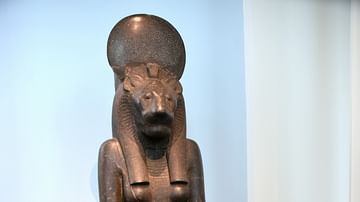
Statue of a Sitting Figure of Goddess Sekhmet
Sekhmet was a lion goddess, whose name means "the mighty one", and she personified the aggressive aspects of other goddesses. Sekhmet was a daughter of the sun god Ra. She usually wears the sun-disc on...
Image
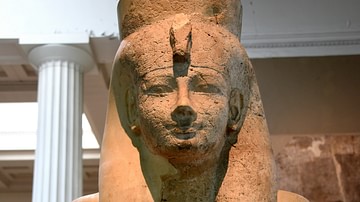
The Goddess Hathor
This bust comes from a triad statue that showed King Amenhotep III flanked by the god Osiris and the goddess Hathor. It is one of the numerous statues that adorned Amenhotep III's mortuary temple at Thebes. Some 150 years later...

Image
Boat of Queen Mutemwia
This sculpture represents a sacred boat on a sledge. It included a seated figure of Queen Mutemwia, wife of Thutmose IV. Only her legs and right hand remained intact, but part of the head is also in the British Museum. Mutemwia...

Article
Daily Life in Ancient Egypt
The popular view of life in ancient Egypt is often that it was a death-obsessed culture in which powerful pharaohs forced the people to labor at constructing pyramids and temples and, at an unspecified time, enslaved...

Article
The Magical Lullaby of Ancient Egypt
The Magical Lullaby (popularly known as Charm for the Protection of a Child) is an inscription from the 16th or 17th century BCE. The poem exemplifies the ancient Egyptian's personal religious and spiritual practices...

Article
The Gifts of Isis: Women's Status in Ancient Egypt
An inscription on an Egyptian papyrus dating from the 2nd century CE relates that the goddess Isis, bestowing gifts on humanity at the beginning of time, gave as much power and honor to women as she...

Article
The Battle of Pelusium: A Victory Decided by Cats
The ancient Egyptians had a great reverence for life in all its forms. Life had been given by the gods and reverence for it extended beyond human beings to all living things. Although the Egyptians did...
