
Search
Did you mean: Amenhotep III?
Remove Ads
Advertisement
Search Results

Interview
Interview: Egyptian Mythology by Garry Shaw
World History Encyclopedia is joined by Egyptologist and author Garry Shaw to chat about his new book Egyptian Mythology: A Traveller's Guide from Aswan to Alexandria. Kelly (WHE): Do you want to start with...

Image
Queen Ahmose-Merytamun
The cobra emblem on the forehead and the Hathoric wig confirms this is a queen. Just as pharaohs were deemed an incarnation of Horus, so did queens embody the goddess Hathor. Ahmose-Merytamun was a sister and wife of Amenhotep...

Definition
The Hittites
The Hittites occupied the ancient region of Anatolia (also known as Asia Minor, modern-day Turkey) prior to 1700 BCE, developed a culture apparently from the indigenous Hatti (and possibly the Hurrian) people, and expanded their...

Definition
Ancient Egyptian Warfare - The Force That Built an Empire
Ancient Egyptian Warfare developed from an army of conscripts in the Pre-Dynastic Period (circa 3150-2613 BCE) through the early era of the Middle Kingdom (2040-1782 BCE), supplied to the king by...

Definition
Moses
Moses (c. 1400 BCE) is considered one of the most important religious leaders in world history. He is claimed by the religions of Judaism, Christianity, Islam, and Bahai as an important prophet of God and the founder of monotheistic belief...
Image
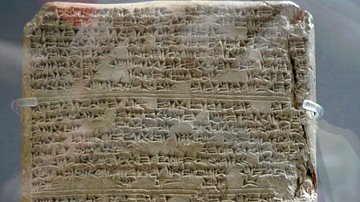
Amarna Letter Tablet from Tushratta
Cuneiform tablet inscribed with a letter from Tushratta, king of Mitanni, to Amenhotep III of Egypt. It was found in Tell el-Amarna and dates from c. 1350 BC, when the city was known as Akhetaten. In this letter...
Image
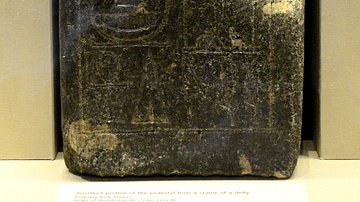
Inscribed Egyptian Statue Pedestal
This inscription has been cut, at an unknown date, from the corner of a statue of a god, one in a series created for the jubilee of pharaoh Amenhotep III in circa 1360 BCE. The god is named in the hieroglyphic inecription...
Article
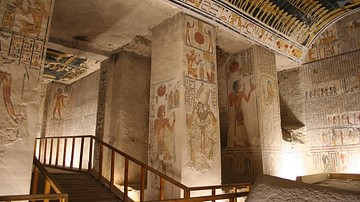
Tomb Robbing in Ancient Egypt
The tombs of the great kings and nobles of Egypt were built to safeguard the corpse and possessions of the deceased for eternity and yet, while many have endured for thousands of years, their contents often disappeared...

Article
The Tale of Sinuhe
The Middle Kingdom of ancient Egypt (2000 BCE – 1700 BCE) saw the start of more formal writing which included religious scripts, administrative notes, and more in-depth fictional writing. One of the most iconic pieces of writing...

Article
Great Female Rulers of Ancient Egypt
Women in ancient Egypt had more rights than in any other ancient culture and were valued with greater respect. This is evident not only in the physical evidence and inscriptions but in their religion. Some of the...
