
Search
Remove Ads
Advertisement
Search Results

Definition
Assyria
Assyria was the region located in the ancient Near East which, under the Neo-Assyrian Empire, reached from Mesopotamia (modern-day Iraq) through Asia Minor (modern Turkey) and down through Egypt. The empire began modestly at the city...

Definition
Neo-Assyrian Empire
The Neo-Assyrian Empire (912-612 BCE) was the final stage of the Assyrian Empire, stretching throughout Mesopotamia, the Levant, Egypt, Anatolia, and into parts of Persia and Arabia. Beginning with the reign of Adad Nirari...

Definition
Ptolemaic Dynasty
The Ptolemaic dynasty was a Macedonian royal family that ruled Ptolemaic Egypt from 323 to 30 BCE. It was founded by Ptolemy I, a general and successor of Alexander the Great. They built Alexandria, including the Lighthouse of...

Article
Sassanian Kings List & Commentary
The Sassanian Empire (224-651) was the greatest expression of Persian culture in the ancient world. It was consciously modeled on the earlier Achaemenid Empire (c. 550-330 BCE) which established Persian supremacy...
Definition
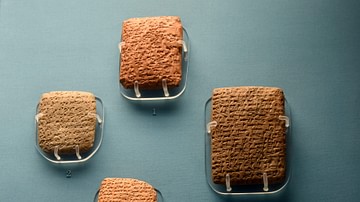
Amarna Letters
The Amarna Letters are a body of 14th-century BCE correspondence exchanged between the rulers of the Ancient Near East and Egypt. They are perhaps the earliest examples of international diplomacy while their most common subjects...
Article
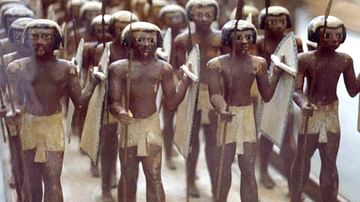
Weapons in Ancient Egypt
The ancient Egyptian military is often imagined in modern films and other media as a heavily armed and disciplined fighting force equipped with powerful weapons. This depiction, however, is only true of the Egyptian army...

Definition
Seleucid Empire
The Seleucid Empire (312-63 BCE) was the vast political entity established by Seleucus I Nicator ("Victor" or "Unconquered", l. c. 358-281 BCE, r. 305-281 BCE), one of the generals of Alexander the Great who claimed a part of...

Article
The Temple of Hatshepsut
Among the duties of any Egyptian monarch was the construction of monumental building projects to honor the gods and preserve the memory of their reigns for eternity. These building projects were not just some grandiose...

Definition
Ancient Egyptian Vizier
The vizier in ancient Egypt was the most powerful position after that of king. Known as the djat, tjat, or tjati in ancient Egyptian, a vizier was the equivalent of the modern-day prime minister of the nation who actually...

Definition
Hatshepsut
Hatshepsut (r. 1479-1458 BCE) was the first female ruler of ancient Egypt to reign as a male with the full authority of pharaoh. Her name means "Foremost of Noble Women" or "She is First Among Noble Women". She began her reign as...
