
Search
Remove Ads
Advertisement
Search Results

Image
The Black Obelisk of Shalmaneser III, side A, 5th register
Tribute from Qarparunda the Patinean: silver, gold, tin, "fast" bronze, ivory (tusks), and ebony. Patina is modern Antakya, south of Turkey. From Nimrud, (ancient Kalhu), near the building...
Image
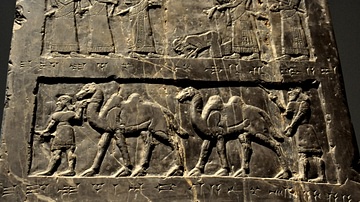
The Black Obelisk of Shalmaneser III, side A, 3rd register
Attendants bring tribute from Musri with two-humped camels. Musri, meaning a borderland, probably refers to a country in eastern Iran or in Egypt. From Nimrud, (ancient Kalhu), near the building...
Definition
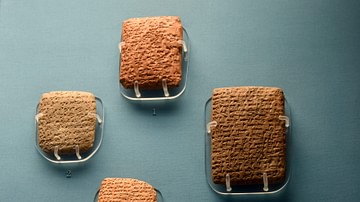
Amarna Letters
The Amarna Letters are a body of 14th-century BCE correspondence exchanged between the rulers of the Ancient Near East and Egypt. They are perhaps the earliest examples of international diplomacy while their most common subjects...

Definition
Ancient Egyptian Vizier
The vizier in ancient Egypt was the most powerful position after that of king. Known as the djat, tjat, or tjati in ancient Egyptian, a vizier was the equivalent of the modern-day prime minister of the nation who actually...

Image
Darius III (Artistic Facial Reconstruction)
A photorealistic representation of the Persian king Darius III (r. 336-330 BCE) as he may have appeared. This reconstruction is largely based on artistic evidence like the Alexander Mosaic (c. 100 BCE) and...

Image
The Black Obelisk of King Shalmaneser III
This obelisk was erected as a public monument in 825 BCE at a time of civil war. The relief sculptures glorify the achievements of King Shalmaneser III and his commander-in-chief . It lists their military campaigns...
Image
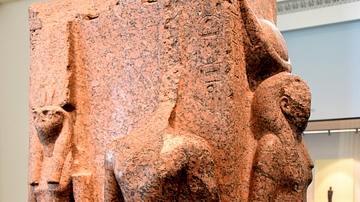
Sculpture of King Thutmose III
This is a rare example of an Egyptian temple sculpture, in which the figures face in 4 different directions. This suggests that it stood in the middle of a room. Three persons are represented twice. King Thutmose III...

Image
Pharaoh Amenhotep III
This is a quartzite head of the Egyptian pharaoh Amenhotep III; the king wears the red crown of Lower Egypt. This style is very typical of the sculpture of Amenhotep III, especially in the depiction of the eyes. It also foreshadows...
Image
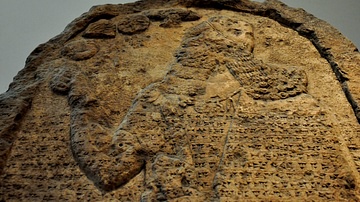
Kurkh Stela of Shalmaneser III
This is a close-up view of the upper part of the stela, depicting Shalmaneser III praying in front of divine symbols (Ashur, Ishtar, Anu, and Sin). The cuneiform inscription is a text of a version of the King's annals...

Image
Red Granite Offering Table of King Senusret III
Offerings were placed upon a reed mat, reproduced in stone as the offering tables of the Dynastic periods. On this royal example, the hieroglyph hetep "offering" is written on the surface. The sign comprises...
