
Search
Did you mean: Anjar?
Remove Ads
Advertisement

 This answer was generated by
 Search Results
Image
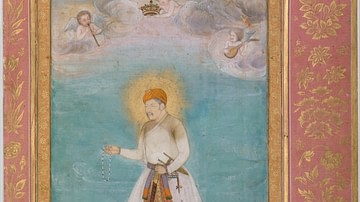
Akbar with a Lion and a Calf
"Akbar With Lion and Calf", Folio from the Shah Jahan Album Painting by Govardhan Calligrapher Mir 'Ali Haravi verso: ca. 1630; recto: ca. 1530–50 This portrait of Akbar from the Shah Jahan album by Govardhan depicts...

Image
Akbar in the Ibadat Khana
Mughal emperor Akbar is seen holding a religious assembly in the Ibadat Khana (House of Worship). Two Jesuit missionaries in black robes are identified as Rudolfo Acquaviva and Francisco Henriques. Illustration to the...
Definition
Ibadat Khana
The House of Worship or the Ibadat Khana was established by Mughal Emperor Akbar (1542-1605 CE) for conducting religious debates and discussions among theologians and professors of different religions. Abu'l-Fath Jalal-ud-din Muhammad...
Image
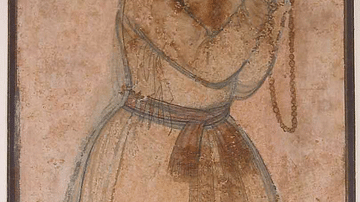
Portrait of Emperor Akbar Praying
Portrait of Emperor Akbar Praying, ink and opaque watercolor on paper, early 17th century, India.
The Metropolitan Museum of Art, New York City.
Image
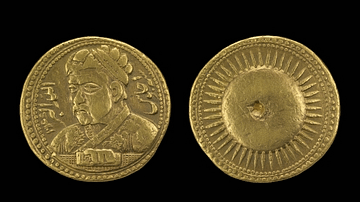
Mughal Gold Coin of Emperor Akbar
A gold mohur coin issued by Mughal Emperor Jahangir (r. 1605-28) bearing a portrait of his Father, Akbar. The coin was issued in 1605, the first year of Jahangir's reign. The inscription in Arabic next to the portrait...
Image
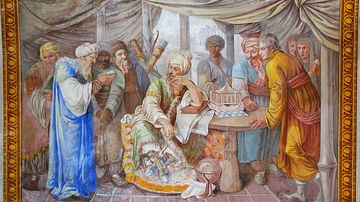
The Court of Akbar
The court of Mughal Emperor Akbar (r. 1556–1605 CE). The man in the yellow robe is identified as Rodolfo Acquaviva.
Painting by an unknown artist, 1847 CE.
Definition
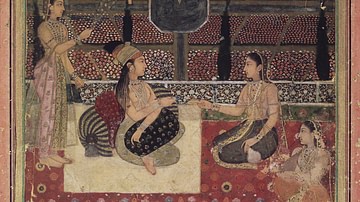
Urdubegis
The urdubegis were a group of female warriors in the Mughal Empire, who protected the zenana, the harem of the emperor. Although the origins of female bodyguards go back to the beginning of Indian civilizations, the urdubegis were...

Article
Retreat from Kabul in 1842
The Retreat from Kabul in 1842 was one of the most notorious disasters in the history of the British Empire. An East India Company army had invaded Afghanistan but was obliged to withdraw. This army of 4,500 soldiers and...

Article
Mandu - City of Joy
The city of Mandu is situated about 35 km from Dhar in the Madhya Pradesh region of northern-central India. Most of the city's monuments date to the 15th and 16th century CE. The city is located on a hill which rises 633 m...

Article
The English and Dutch East India Companies' Invasions of India
In the early 17th century, the Dutch and English East India Companies turned their eyes towards India, as part of their grand schemes to develop extensive trade networks across the Indian and...
