
Search
Did you mean: Aesop's Fables?
Remove Ads
Advertisement
Search Results

Definition
Naram-Sin - The God-King of Akkad
Naram-Sin (reign 2254-2218 BCE) was the last great king of the Akkadian Empire and the grandson of Sargon the Great (reign 2334-2279 BCE), who founded the empire. He is considered the most important Akkadian king...

Definition
Abraham Lincoln - Preserver of the Union
Abraham Lincoln (1809-1865) was an American lawyer and politician who served as the sixteenth president of the United States. He led the country through the tumultuous period of the American Civil War (1861-1865...

Definition
Walter Raleigh
Sir Walter Raleigh (c. 1552-1618 CE) was an English courtier, soldier, mariner, explorer, and historian. A one-time favourite of his queen, Elizabeth I of England (r. 1558-1603 CE), Raleigh organised three expeditions to form a...

Definition
Christine de Pizan
Christine de Pizan (also given as Christine de Pisan, l. 1364 - c. 1430) was the first female professional writer of the Middle Ages and the first woman of letters in France. Her best-known works advocated for greater equality...

Definition
Diogenes of Sinope
Diogenes of Sinope (l. c. 404-323 BCE) was a Greek Cynic philosopher best known for holding a lantern (or candle) to the faces of the citizens of Athens claiming he was searching for an honest man. He rejected the concept of...
Definition
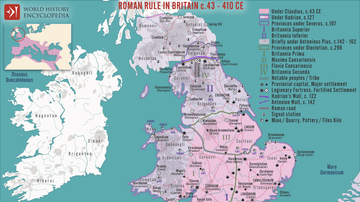
Roman Britain
Britain was a significant addition to the ever-expanding Roman Empire. For decades, Rome had been conquering the Mediterranean Sea – defeating Carthage in the Punic Wars, overwhelming Macedon and Greece, and finally marching into...

Article
Mesopotamian Inventions - Creating the Future
Mesopotamian inventions include many items taken for granted today, most of which were created during the Early Dynastic period (circa 2900-2350/2334 BCE) or developed from achievements of the Uruk period...

Article
Ten Ancient Mesopotamia Facts You Need to Know - Fun Facts on the Cradle of Civilization
Mesopotamia is the ancient Greek name (meaning "the land between two rivers," the Tigris and Euphrates) for the region corresponding to modern-day Iraq and parts of Iran...

Article
Chaucer's The Book of the Duchess Full Text & Summary
The Book of the Duchess is the first major work of the English poet Geoffrey Chaucer (l. c. 1343-1400 CE), best known for his masterpiece The Canterbury Tales, composed in the last twelve years of...

Article
Twelve Famous Women of the Middle Ages
Women in the Middle Ages were frequently characterized as second-class citizens by the Church and the patriarchal aristocracy. Women's status was somewhat elevated in the High and Late Middle Ages by the cult...
