
Search
Did you mean: Aesop's Fables?
Remove Ads
Advertisement
Search Results

Article
Saladin's Conquest of Jerusalem (1187 CE)
Jerusalem, a holy city for the adherents of all three great monotheistic religions (Judaism, Christianity, and Islam) was conquered by the armies of the First Crusade in 1099 CE. The Muslims failed to halt...

Article
Ancient Persian Gods, Heroes, and Creatures - The Complete List
The term 'mythology' comes from the Greek mythos (story-of-the-people) and logos (word or speech), meaning the spoken story of a people. Every civilization of the ancient world developed a...

Article
Sumerian Civilization: Inventing the Future
Imagine something that has never been thought of before. If one holds a book in one's hands, one can imagine an e-book, a large-print book, a picture book, all kinds of books. But how does one imagine a book...

Article
The Marduk Prophecy - Travels of the Statue of a Babylonian God
The Marduk Prophecy is an Assyrian document dating to between 713 and 612 BCE found in a building known as The House of the Exorcist, adjacent to a temple in the city of Ashur. It relates the...
Article
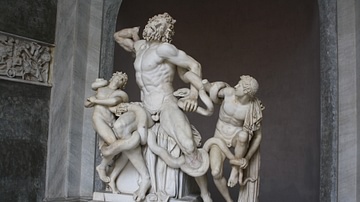
Laocoön: The Suffering of a Trojan Priest & Its Afterlife
The sculpture group of Laocoön and His Sons, on display in the Vatican since its rediscovery in 1506, depicts the suffering of the Trojan prince and priest Laocoön (brother of Anchises) and his...

Article
The Frog Princess
The Frog Princess is a Slavic folktale focusing on the importance of recognizing someone’s inner beauty, regardless of their outward appearance, as well as the possibility of redemption after failure. The tale has many variants...

Article
The Life of Antisthenes of Athens in Diogenes Laertius
Antisthenes (c. 445-365 BCE) was a Greek philosopher who founded the Cynic School of Athens. He was a follower of Socrates and appears in Plato's Phaedo as one of those present at Socrates' death...

Article
8 Sonnets and Songs by William Shakespeare
The literary works of William Shakespeare (l. c. 1564-1616) are often regarded as some of the most important in the English language. Alongside his famous plays, he also wrote poems, including 154 sonnets...
Image
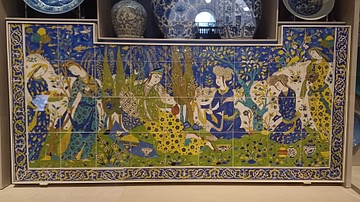
Persian Miniature Tile-Painting of a Garden Scene
Persian miniature painting on a tile, earthenware under coloured glazes, probably from Isfahan, 17th century CE. Victoria and Albert Museum, London. The so-called 'garden scenes' are among the most...

Image
The Dog, the Baby, and the Viper
Child Asleep in a Cradle Under the Care of a Brave Dog Who Just Killed Near Him a Huge Viper, oil on canvas painting by Jeanne Élisabeth Chaudet, c. 1801. Inspired by a late 18th-century book of fables, the story...
