
Search
Did you mean: Babylon?
Remove Ads
Advertisement
Search Results
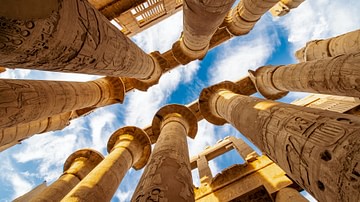
Image Gallery
A Gallery of Ancient Egyptian Temples
The temple in ancient Egypt was the home of the deity it was built for, and the clergy attended the statue of that god or goddess as they would a living person. Every temple was designed with a forecourt, a reception...
Image
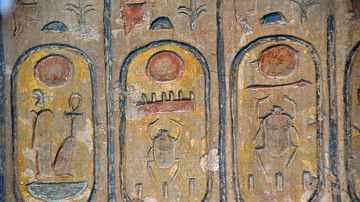
King-list of Egypt, Detail of the 18th Dynasty
A pharaoh was known primarily by his throne name. This was traditionally a statement about his divine father, the sun-god Ra, so all cartouches with throne names display a sun-god at the top. A king's birth...

Image
Egyptian King-list
Monumental lists of past kings expressed the living ruler's legitimacy. Originally, Ramesses II was shown on the far right, honoring previous kings and the god Osiris. The kings were represented by their throne names, written...
Image
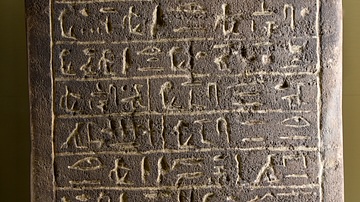
Egyptian stela of Sehetepibre and others
On this sandstone stela, there are 10 lines of hieroglyphs inside the border line. The stela mentions the name of the guard of the bureau of fields, Sehetepibre (born of Ite). From the Tombs of The Courtiers...

Image
Sandal Ivory Label of Pharaoh Den
One of the Egyptian king's principal duties was to defend and expand the borders of Egypt. This ivory label, once tied to a pair of sandals, depicts king Den smiting a foreigner from the east. Rock carvings of Den...
Image
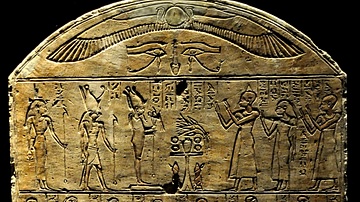
Stela of Padipakhered
Limestone stela of Padipakhered, a priest of the Ka. From Abydos, modern-day Egypt. Saite period, 26th Dynasty, 580-530 BCE. (State Museum of Egyptian Art, Munich, Germany).

Image
Stela of Hesu from the Old Kingdom of Egypt
This limestone stela bears a sunk relief of a man. The man is standing and right-facing; he holds staves. At the lower right corner, a smaller scale figure of woman appears; she wears a a long dress and holds...
Image
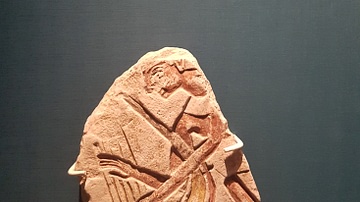
Egyptian Harp Player
Egyptian relief of a harp player. 19th Dynasty, about 1295-1186 BCE. Abydos, Egypt. From The British Museum, (photo taken at the Powerhouse Museum, Sydney, Australia)
Image
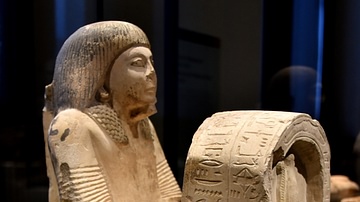
Statue of Setau
Kneeling figure of Setau, Viceroy of Kush, holding a stela (stelophor).Limestone. New Kingdom, 19th Dynasty, reign of Ramesses II, 1279-1213 BCE. Probably from Abydos, Egypt. (The Neues Museum, Berlin, Germany).
Image
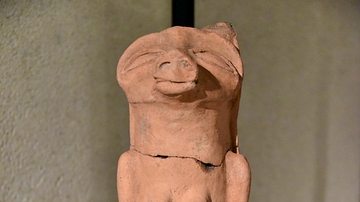
Statuette of a Hybrid Goddess
Fired clay statuette of an unidentified hybrid goddess. There are two triangular defects at the sides, reminiscent of prehistoric incense burners. Probably from Abydos, Egypt. First to second Dynasty, 3100-2700 BCE...
