
Search
Did you mean: Babylon?
Remove Ads
Advertisement
Search Results
Image
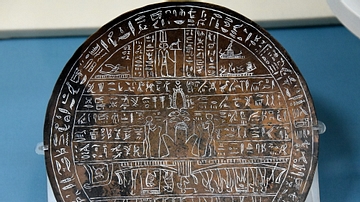
Bronze Hypocephalus of Djedhor
Hypocephali are inscribed discs usually of plastered linen and less frequently of papyrus or bronze, which were placed beneath the heads of mummies in the Late/Ptolemaic Periods. The texts written on them were taken...
Image
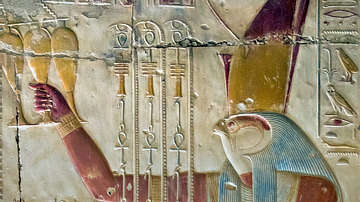
Relief of Horus, Temple of Seti
A section of a relief from a chapel in the Temple of Seti, depicting Horus holding three joined gold vases. Abydos, Egypt. 19th Dynasty (1292-1186 BCE). (Image cropped from original)

Image
Den
An ivory lable fragment depicting the Egyptian king Den (c. 2990 BCE) who ruled during the First Dynasty. He is the first ruler to be depicted wearing the double crown of Upper and Lower Egypt. Abydos, Umm el Qaab, tomb T, the Tomb of Horus...

Image
Egypt's Sixth Dynasty Kings
The kings of Egypt's 6th Dynasty from the Abydos King List.
Image
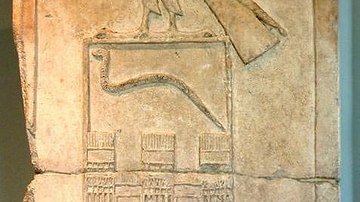
Tombstone of Djet
A tombstone of the First Dynasty pharaoh Djet, reign c. 3000-2990 BCE. From Abydos, Egypt. (Louvre Museum, Paris)
Image
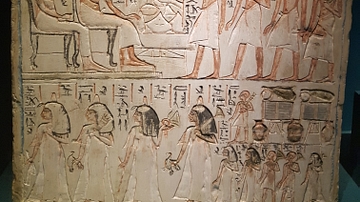
Stela Of Qeh
Stela of Qeh, early 19th Dynasty, about 1250 BCE. Probably from Abydos, Egypt. The British Museum, (photo taken at The Powerhouse Museum, Sydney, Australia) Priests made offerings of food and drink to both the gods and the dead...
Image
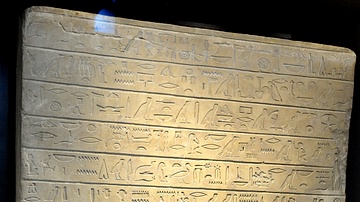
Stela of Sobeki
Limestone stela of the Egyptian nomarch Sobeki. From Abydos, modern-day Egypt. Middle Kingdom, 12th Dynasty, circa 1900 BCE. (State Museum of Egyptian Art, Munich, Germany).
Image
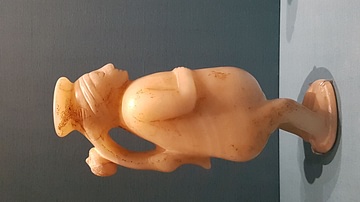
Egyptian Vase In the Form Of A Pregnant Woman
Egyptian calcite vessel in the form of a pregnant woman. Its handle represents a child holding the woman's hair. 18th Dynasty, about 1479-1352 BCE. Found in Tomb 949, Abydos, Egypt. The British Museum...
Image
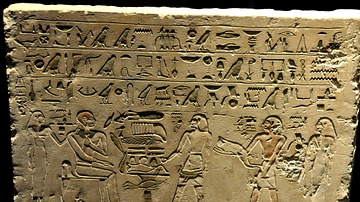
Stela of Usekhu
Limestone stela of Usekhu, the overseer of the cabinet. From Abydos, modern-day Egypt. Middle Kingdom, circa 11th to 12th Dynasty, circa 2000 BCE. (State Museum of Egyptian Art, Munich, Germany).
Image
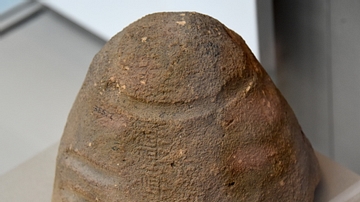
Jar Sealing of Narmer
The name Narmer, written as a catfish within a serekh (royal name box), has been impressed with a large cylinder seal several times onto this conical jar lid. The chisel, the second element of Narmer's name and perhaps originally...
