
Search
Did you mean: Babylon?
Remove Ads
Advertisement
Search Results

Article
The Battle of Kadesh & the Poem of Pentaur
The Poem of Pentaur is the official Egyptian record (along with The Bulletin) of the military victory of Ramesses II (known as The Great, 1279-1213 BCE) over the Hittite King Muwatalli II (1295-1272 BCE) at...

Article
The Battle of Pelusium: A Victory Decided by Cats
The ancient Egyptians had a great reverence for life in all its forms. Life had been given by the gods and reverence for it extended beyond human beings to all living things. Although the Egyptians did...

Article
Great Female Rulers of Ancient Egypt
Women in ancient Egypt had more rights than in any other ancient culture and were valued with greater respect. This is evident not only in the physical evidence and inscriptions but in their religion. Some of the...

Article
Gods & Goddesses of Ancient Egypt - A Brief History
The land of ancient Egypt was alive with the spirit of the gods. The sun god Ra broke from the darkness every morning in his great boat, bringing the light, and many of the gods watched over the people...

Article
The Delian League, Part 6: The Decelean War and the Fall of Athens (413/2-404/3 BCE)
This text is part of an article series on the Delian League. The sixth and last phase of the Delian League begins with the Decelean War, also referred to as the Ionian War...

Article
Ships of the Gods of Ancient Egypt
The Nile River was the source of life for the ancient Egyptians and so figured prominently in their religious beliefs. At night, the Milky Way was considered a heavenly Nile, associated with Hathor, and provider...

Article
The Poems of Christopher Marlowe
Christopher Marlowe (1564-1593), also known as Kit Marlowe, was one of the most influential dramatists of Elizabethan theatre. Though he is best known for his plays, his poems were very popular in their time and are...

Image
Egyptian Serekh
Currently located in the Louvre Museum, this Funerary stela was found at Abydos. It is an example of an Egyptian Royal Serekh from the 1st Dynasty. This writing format indicated that the name inside the rectangular enclosure was...
Image
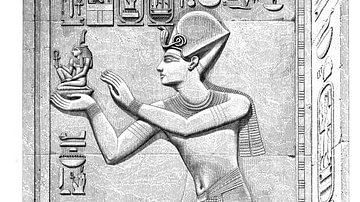
Seti I
J. Sulpis del. et sc.
SETI I
BAS-RELIEF AT ABYDOS
From A History of Art in Ancient Egypt, Vol. I by Georges Perrot and Charles Chipiez (1883).
Image
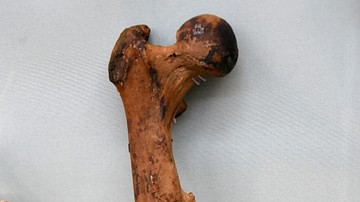
Fractured Femur of an Egyptian Mummy
This right femoral bone shows evidence of malunion and misalignment of a healed fractured. From Abydos, Egypt. Late Period, after 664 BCE. (The British Museum, London)
