
Search
Search Results

Definition
Islam
Islam is an Abrahamic-monotheistic religion based upon the teachings of Prophet Muhammad ibn Abdullah (l. 570-632 CE, after whose name Muslims traditionally add “peace be upon him” or, in writing, PBUH). Alongside Christianity and Judaism...

Definition
Uthman
Uthman ibn Affan (l. 576/583-656 CE) was an early convert to Islam, a close friend and son-in-law of Prophet Muhammad (l. 570-632 CE), and the third caliph (r. 644-656 CE) of the Rashidun Caliphate (632-661 CE). His charitable acts and modesty...
Collection
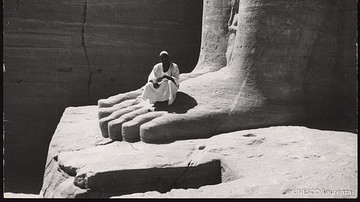
UNESCO's Nubia & Abu Simbel Campaign
This collection is really dear to us as it is the fruit of our new collaboration and partnership with the UNESCO Archives. They have digitized a vast amount of resources that can be found on their platform and you can read all about their...

Definition
Prophet Muhammad
Muhammad ibn Abdullah (l. 570-632 CE) is venerated today as the Prophet of Islam and the “seal of Prophets” by his followers – the Muslims. Muslims believe that Muhammad was the last – hence the “seal” – of many prophets before him in Judaism...

Definition
Rashidun Government
The Rashidun Caliphate (632-661 CE) was responsible for setting up the basis of the Islamic empire and expanding its borders beyond the Arabian soil. These leaders were selected by the consent of the people and based on their own merits...
Article
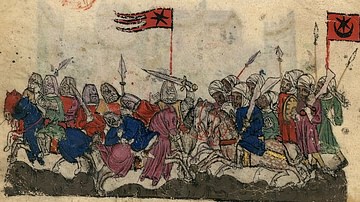
Battle of Yarmouk
The Battle of Yarmouk River (or Yarmuk River; also written as the Battle of Jabiya-Yarmuk) was fought over the course of six days, from 15 to 20 August 636 CE, between the Muslim army of the Rashidun Caliphate (632-661 CE), under Khalid ibn...
Image
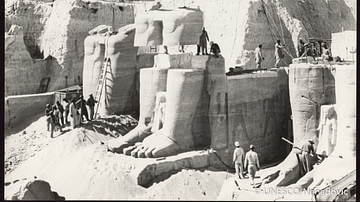
Dismantling of Abu Simbel Statues, 1966
Dismantling of the statues of the Great Temple at Abu Simbel during the International Campaign for the Safeguard of the Nubian Monuments launched by UNESCO.
Abu Simbel, Egypt, Nubia (9 February 1966)

Image
Scaffolding Arch of Abu Simbel Great Temple, 1966
International campaign for the safeguarding of the Nubian monuments launched by UNESCO. In this photo, you can see the first arch of the scaffolding for the dome of the Great Temple of Abu Simbel under erection on its new site. Abu Simbel...

Definition
Ali ibn Abi Talib
Ali ibn Abi Talib, or simply Ali, (l. 601-661 CE) was among the first Muslims, a cousin and son-in-law of the Islamic Prophet Muhammad (l. 570-632 CE), and later reigned as the fourth Caliph of Islam from 656 CE to 661 CE, when he was murdered...
Image
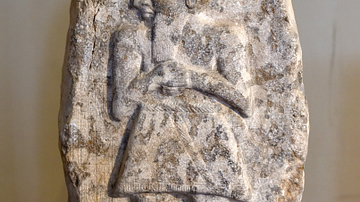
Akkadian Stele of Ilšu-rabi from Tell Abu Sheeja
The stele was found at Tell Abu Sheeja, north of modern-day Amarah city, Maysan Governorate, Iraq. The Old Akkadian cuneiform inscription on the left side of the viewer mentions the name of the city of Pašime. Pašime lies western to the ancient...
