
Search
Remove Ads
Advertisement
Search Results

Image
Detail of a 6th-century Elephant Mosaic
Detail of a 6th-century mosaic floor that used to decorate the pavement of the peristyle court of the Palatium Magnum, the Great Palace of Constantinople. The Great Palace Mosaic Museum houses mosaics from the...

Image
East Roman Empire, 6th century CE
East Roman Empire, 6th century CE, showing the territories of the Avars, Goths, Franks, Lombards, Saxons, Thuringians, Slavs.

Image
Roman Forum in the 5th Century BCE
A painting of the Roman Forum as it probably would have appeared in the 5th Century BCE. By Vilius Petrauskas.
Courtesy of Ancient History Magazine / Karwansaray Publishers.

Image
5th Century BCE Demareteion Coin
An illustration of the so-called Demaretéion is a silver coin of ancient Syracuse (weighing around 43 g) rather rare and worth 10 drachmas. It is also known as a pentekontalitron because it was equivalent to 50 litrae...
Image
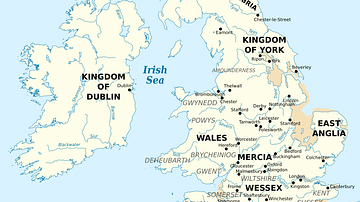
British Isles at the Beginning of the 10th Century
British Isles in 10th century represented with the coastline at the time.

Image
Janissary Uniform, Early 19th Century
Illustration of a Janissary's uniform, drawing by John Heaviside Clark, included in Thomas McLean's The Military Costume of Turkey. Illustrated by a Series of Engravings, from Drawings Made on the Spot, plate...
Image
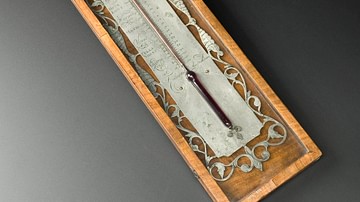
18th-Century Alcohol Thermometer
An 18th-century alcohol thermometer. Made in the Netherlands between 1720 and 1750. (Science Museum, London)

Image
Monte Cassino in the 15th Century
Illustration of Monte Cassino in the 15th-century Nuremberg Chronicle. Published in Nuremberg, Germany, 1493.

Image
18th-century Mughal Miniature Quran
A miniature Qur'an in vellum binding. Mughal Empire, 18th century. (Victoria and Albert Museum, London)
Image
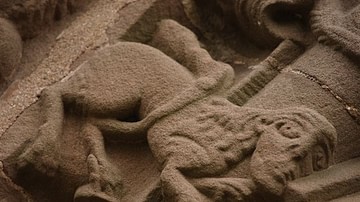
Manticore at the Church of St Mary and St David, Kilpeck, Herefordshire (12th century)
Kilpeck church stone carvings: Manticore. Dating to the 12th century and found at the Church of St Mary and St David in Herefordshire, England.
