
Search
Remove Ads
Advertisement
Search Results

Definition
Ashoka the Great
Ashoka the Great (r. 268-232 BCE) was the third king of the Mauryan Empire (322-185 BCE) best known for his renunciation of war, development of the concept of dhamma (pious social conduct), and promotion of Buddhism as well as his effective...

Interview
Interview: Bejeweled Sri Lanka
The first comprehensive survey of Sri Lankan art organized by an American museum, The Jeweled Isle: Art from Sri Lanka, on show now at the LACMA in Los Angeles, California, presents some 250 works addressing nearly two millennia of Sri Lankan...

Article
Cultural Links between India & the Greco-Roman World
Cyrus the Great (558-530 BCE) built the first universal empire, stretching from Greece to the Indus River. This was the famous Achaemenid Empire of Persia. An inscription at Naqsh-i-Rustam, the tomb of his able successor Darius I (521-486...

Definition
Sutra
A sutra (Sanskrit for “thread”) is a written work in the belief systems of Hinduism, Jainism, and Buddhism which is understood to accurately preserve important teachings of the respective faiths and guide an adherent on the path from ignorance...

Article
Life in a Japanese Buddhist Monastery
Buddhist monasteries have been part of the Japanese cultural landscape ever since the 7th century CE, and they remained both powerful and socially important institutions right through the medieval period. Today, many of Japan's finest examples...
Definition
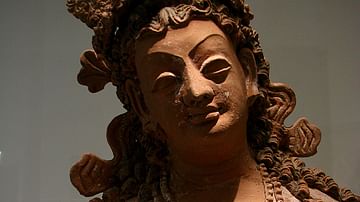
Mahasanghika
Mahasanghika (“Great Congregation”, also given as Mahasamghika) was an early Buddhist school of thought which is thought to have been formed after the Second Buddhist Council of 383 BCE when it separated itself from another school, the Sthaviravada...

Video
The Three Schools of Buddhism: Intro
We will look at the three major schools of Buddhism, in the sort of contemporary context YouTubers would be likely to encounter them. We'll highlight some of the similarities and differences in their styles of belief and practice. This is...

Definition
Siddhartha Gautama
Siddhartha Gautama (better known as the Buddha, l. c. 563 - c. 483 BCE) was, according to legend, a Hindu prince who renounced his position and wealth to seek enlightenment as a spiritual ascetic, attained his goal and, in preaching his path...

Definition
Ajanta
Approximately 67 miles (107 km) to the north of Aurangabad in the Indhyadri range of Western Ghats lie the caves of Ajanta. The 30 caves, famous for their early Buddhist temple architecture and many delicately drawn murals, are located in...

Definition
Four Noble Truths
The Four Noble Truths are the foundational tenets of Buddhism, which spark awareness of suffering as the nature of existence, its cause, and how to live without it. The truths are understood as the realization which led to the enlightenment...
