
Search
Remove Ads
Advertisement
Search Results

Definition
Asuka Period
The Asuka Period (Asuka Jidai) of ancient Japan covers the period from 538 CE to 710 CE and, following on from the Kofun Period (c. 250-538 CE), so constitutes the latter part of the Yamato Period (c. 250-710 CE). For some scholars the period...

Definition
Tang Dynasty
The Tang Dynasty (618-907 CE) was one of the greatest in Imperial Chinese history. It was a golden age of reform and cultural advancement which lay the foundation for policies which are still observed in China today. The second emperor, Taizong...

Article
Ten Great Stupas from Around the World
A stupa is a reliquary containing the remains (relics) of an individual associated with great spiritual power and insight, most often (since the 3rd century BCE) with the Buddha (l. c. 563 - c. 483 BCE). The form, a hemisphere topped by a...
Article
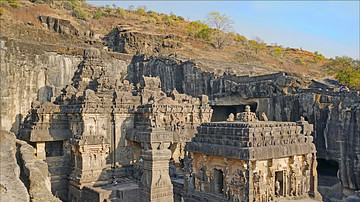
Ellora Caves
Ellora (also known as Elura and, in ancient times, as Elapura) is a sacred site in Maharastra, central India. The Ellora Caves are listed by UNESCO as a World Heritage Site and is celebrated for its Hindu, Buddhist, and Jain temples and monuments...

Definition
Kofun Period
Following the Yayoi Period of Japan when farming and metalworking techniques were introduced from mainland Asia was the Kofun Period (c. 250 CE - 538 CE) where the religion of Shinto emerges from the beliefs of previous eras and the Yamato...

Definition
White Huns (Hephthalites)
The White Huns were a race of largely nomadic peoples who were a part of the Hunnic tribes of Central Asia. They ruled over an expansive area stretching from the Central Asian lands all the way to the Western Indian Subcontinent. Although...

Definition
Mount Koya
Mount Koya (aka Koyasan), located in the Wakayama Prefecture, south of Osaka, Japan, is the site of a temple complex founded in 819 CE by the scholar monk Kukai as the headquarters for Shingon Buddhism. There are temples and sacred buildings...

Article
Religion in the Mongol Empire
The Mongol Empire (1206-1368 CE) covered Asia from the Black Sea to the Korean peninsula and so naturally included all manner of religions within its borders, but the Mongols themselves had their own particular religious beliefs and rituals...

Definition
Harsha
Emperor Harshavardhana, better known as Harsha, lived from 590 to 647 CE and was the last ruler of the Vardhana Empire, the last great empire in ancient India before the Islamic Invasion. He ruled from 606 CE to 647 CE. After Harshavardhana's...

Definition
Todaiji
Todaiji is an ancient temple complex in Nara, Japan. Founded in 738 CE and officially opened in 752 CE when Nara was the capital, the temple is the headquarters of the Buddhist Kegon sect. The temple has a 500-ton sculpture of the Buddha...
