
Search
Remove Ads
Advertisement
Search Results
Definition
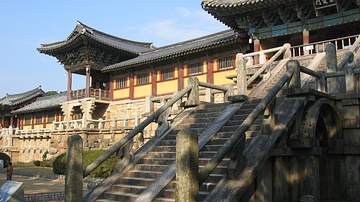
Bulguksa Temple
The Bulguksa Temple (aka Pulguk-sa Temple or 'Temple of the Buddha Land') was built in the 8th century CE on the wooded slopes of Mt. Tohamsan at the ancient Silla capital of Geumseong (modern Gyeongju, South Korea). The Buddhist temple...
Article
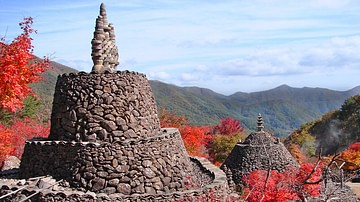
Shamanism in Ancient Korea
Shamanism was widely practised in Korea from prehistoric times right up to the modern era. It is a belief system which originated in north-east Asian and Arctic cultures, and although the term shamanism has since acquired a wider meaning...

Definition
Civilization - From Nomadic Life to the Farm and City
Civilization (from the Latin civis=citizen and civitas=city) is a term applied to any society which has developed a writing system, government, production of surplus food, division of labor, and urbanization. The term is difficult to define...

Article
Buddhist Illuminated Scripts of Ancient Korea
The Goryeo (Koryo) kingdom ruled ancient Korea from 918 CE to 1392 CE, and it oversaw a flourishing of the arts, literature, and architecture. One of these developments was the production of finely crafted illuminated Buddhist texts. Painted...

Definition
Jainism
Jainism is one of the oldest religions in the world. The name comes from jiva (soul or life force but, capitalized, is also given as Spiritual Conqueror) as it maintains that all living things possess an immortal soul which has always and...
Definition
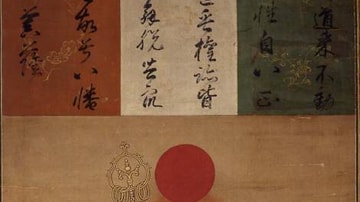
Hachiman - Origin of the Kamikaze Wind
Hachiman is the ancient Shinto god or kami of war, divination, and culture. He is famously credited with sending the kamikaze or 'divine wind' which twice dispersed the invading fleets of Mongol ruler Kublai Khan in the 13th century CE. This...

Definition
Taejo of Goryeo
Taejo (r. 918-943 CE), previously known as Wang Geon or Wang Kon, was the founder and first king of the Goryeo (Koryo) kingdom which unified and ruled ancient Korea from 918 CE to 1392 CE. Wang Geon was given the posthumous title of Taejo...

Article
15 Complete Hyangga Songs from Ancient Korea
Hyangga was a form poetical 'country song,' distinct from contemporary Chinese songs, which were written in the Silla and Goryeo kingdoms of ancient Korea between the 7th and 10th century CE. The indigenous songs cover such topics as love...

Definition
Philosophy
The word philosophy comes from the Greek philo (love) and sophia (wisdom) and so is literally defined as “the love of wisdom”. More broadly understood, it is the study of the most basic and profound matters of human existence. Philosophical...

Definition
Kapilavastu
Kapilavastu (“Place of Kapila”) is the name of the city where Siddhartha Gautama (the Buddha, l. c. 563-483 BCE) grew up and lived for the first 29 years of his life before leaving to pursue the spiritual path which led to his enlightenment...
