
Search
Remove Ads
Advertisement
Search Results

Definition
Renaissance Humanism
Renaissance Humanism was an intellectual movement typified by a revived interest in the classical world and studies which focussed not on religion but on what it is to be human. Its origins went back to 14th-century Italy and such authors...
Definition
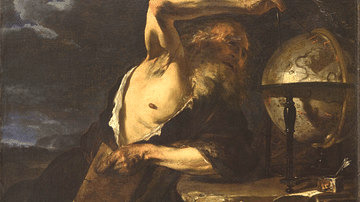
Anaxagoras
Anaxagoras (l. c. 500-c. 428 BCE) was a Pre-Socratic Greek philosopher who claimed the First Cause of existence was Mind (nous) and all things were constituted of indestructible “seeds” (or “stuff”), originally a single mass, separated and...

Article
Death of Alexander the Great
In June of 323 BCE, Alexander the Great (r. 336-323 BCE) died in Babylon. His sudden death before his 33rd birthday has long been a point of speculation: was it disease, old wounds, or murder? Regardless of the cause, history ranks him as...

Definition
Periander
Periander was the second tyrant of Corinth (d. c. 587 BCE); Diogenes Laertius only mentions that he was eighty when he died, meaning that he was probably born c. 667 BCE. His father Cypselus (r. 657-627 BCE), from whom the short-lived Cypselid...

Definition
Library of Alexandria
The Library of Alexandria was established under the Ptolemaic Dynasty of Egypt (323-30 BCE) and flourished under the patronage of the early kings to become the most famous library of the ancient world, attracting scholars from around the...

Definition
Greek Archaic Period
The Greek Archaic Period (c. 800-479 BCE) started from what can only be termed uncertainty, and ended with the Persians being ejected from Greece for good after the battles of Plataea and Mykale in 479 BCE. The Archaic Period is preceded...

Definition
Claudius Ptolemy
Claudius Ptolemy (c. 100 to c. 170 CE) was an Alexandrian mathematician, astronomer, and geographer. His works survived antiquity and the Middle Ages intact, and his theories, particularly on a geocentric model of the universe with planets...

Definition
Argead Dynasty
The Argead dynasty, the ancient Macedonian house of Dorian Greek origin, lasted from the 7th century to 310 BCE. The mythological founder of the dynasty was King Caranus but it was under Philip II of Macedon (382-226 BCE) that the Macedonian...

Article
The Hellenistic World: The World of Alexander the Great
The Hellenistic World (from the Greek word Hellas for Greece) is the known world after the conquests of Alexander the Great and corresponds roughly with the Hellenistic Period of ancient Greece, from 323 BCE (Alexander's death) to the annexation...
Article
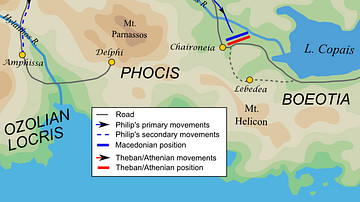
The Battle of Chaeronea in Diodorus Siculus
Chaeronea is the site of the famous Battle of Chaeronea (338 BCE) Phillip II of Macedon's decisive defeat of the Greek city-states. At Chaeronea in Boeotia (north of Corinth) Phillip and his allies from Thessaly, Epirus, Aetolia, Northern...
