
Search
Remove Ads
Advertisement
Search Results

Definition
Phocion
Phocion (c. 402 – 318 BCE) was an Athenian statesman and military commander who, according to tradition, was made a general a staggering 45 times. A student of Plato and known as 'the Good', his political position was somewhat ambiguous...

Definition
Jean-Paul Sartre
Jean-Paul Sartre (1905-1980) was a French existentialist philosopher who defined the existentialist movement in the 20th century. Considered the consummate intellectual, he was not only the author of philosophical works but also a biographer...

Article
Warrior Women of the World of Ancient Macedon
The 8th November is celebrated as Archangels Day in Greece, but on that November day in 1977 CE something remarkable happened: an excavation team led by Professor Manolis Andronikos were roped down into the eerie gloom of an unlooted Macedonian-styled...

Article
Diodorus Siculus on Fate and Philip of Macedon
Diodorus Siculus, the 1st century BCE historian, took great pride in precision of description but, even so, could not refrain from adding his own personal views and interpretations of historical events and persons. In the following passage...

Definition
Antikythera Mechanism
The Antikythera mechanism (also known as the Antikythera Device), dated to the late 2nd century/early 1st century BCE (roughly 205-60 BCE) is understood as the world's first analog computer, created to accurately calculate the position of...

Definition
Perdiccas
Perdiccas (d. 321 BCE) was one of Alexander the Great's commanders, and after his death, custodian of the treasury, regent over Philip III and Alexander IV, and commander of the royal army. When Alexander the Great crossed the Hellespont...

Article
The Printing Revolution in Renaissance Europe
The arrival in Europe of the printing press with moveable metal type in the 1450s CE was an event which had enormous and long-lasting consequences. The German printer Johannes Gutenberg (c. 1398-1468 CE) is widely credited with the innovation...

Image
The School of Athens by Raphael
The School of Athens by Raphael, painted between 1510-1511 CE, depicting all of the major philosophers of antiquity with Plato and Aristotle at the centre. (Vatican Museums, Rome).

Article
Jesuit Influence on Post-medieval Chinese Astronomy
Ancient China had seen little Western contact before the 16th century CE, the language, culture and science all being allowed to develop independently of foreign influence. By the time European Jesuit missionaries arrived in the 16th century...
Definition
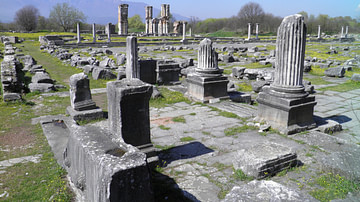
Philippi
Philippi was an important city in eastern Macedon which flourished in the Hellenistic, Roman, and Byzantine Periods. Situated between the Strymon and Nestos rivers, the city was valued in antiquity for its nearby gold mines. Site of the famous...
