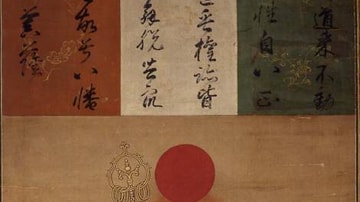
The Shinto Religion

Marion Wadowski
by
published on
bookmark_addbookmark_addedSave Collection

Shinto is the oldest religion in Japan and has become an integral part of that country's culture whether it be in daily worship and ritual, the famous tourist site shrines or the appearance of Shinto characters in contemporary comics and films. Curiously, the religion has no founder, prophets or sacred texts, but there are certainly many gods and spirits, perhaps more than in any other religion because Shinto belief holds that even striking geographical features such as mountains and lakes can have within them a divine spirit or kami. In addition, many Buddhist deities have become established members of Shinto's vastly varied cast of supernatural beings. Worshipped at shrines where offerings are given and ceremonies performed in their honour, kami are appealed to and appeased so that the key concepts of the religion might be attained: purity, harmony, family respect, and subordination of the individual to the group.

In this collection, we look at some of the more colourful figures from the Shinto story as retold in seminal works like the Nihon Shoki, examine the particular architectural features common to shrines and sacred places like the Ise Grand Shrine, and discover some of the revered historical figures who have made the leap into sainthood and immortality in Japanese culture.

Izanagai no Mikoto and Izanami ni Mikoto stood on the floating bridge of Heaven, and held counsel together, saying: “Is there not a country beneath?” Thereupon they thrust down the jewel-spear of Heaven, and groping about therewith found the ocean. The brine dripped from the point of the spear coagulated and became an island which received the name of Ono-goro-jima.

(The Creation of Japan, Nihon Shoki)

Articles & Definitions

Shinto
Definition

Shinto

Shinto means 'way of the gods' and it is the oldest religion in Japan. Shinto's key concepts include purity, harmony, family respect...
Shinto Architecture
Definition

Shinto Architecture

The architecture of the 80,000 Shinto shrines in Japan varies depending on geographical location, the deity worshipped, and...
Nihon Shoki
Definition

Nihon Shoki

The Nihon Shoki ('Chronicle of Japan' and also known as the Nihongi) is an official history of Japan which was written by a committee...
Yomi
Definition

Yomi

Yomi, or Yomi-tsu-kuni, is the underworld of the Shinto religion, even if it forms no part of Shinto theology and appears only in ancient...
Heiankyo
Definition

Heiankyo

Heiankyo (Kyoto), located in the centre of Honshu island, was the capital of Japan for over a thousand years and gave its name to one...
Inari
Definition

Inari

Inari is the Shinto god of rice, the protector of food, and bringer of prosperity. He has over 40,000 shrines dedicated to him large and...
Kagutsuchi
Definition

Kagutsuchi

Kagutsuchi (aka Hi-no-Kagutsuchi) is the Shinto god or kami of fire and is also known as Homusubi. The son of Izanami and Izanagi...
Izanami and Izanagi
Definition

Izanami and Izanagi

Izanami ('she who invites') and Izanagi ('he who invites') are the primordial gods of the Shinto religion who are believed...
Kojiki
Definition

Kojiki - Japan's Oldest Book

The Kojiki ('Record of Ancient Things') is the oldest book of Japanese history and the oldest text of any kind from Japan...
Hachiman
Definition

Hachiman - Origin of the Kamikaze Wind

Hachiman is the ancient Shinto god or kami of war, divination, and culture. He is famously credited with sending...
Ise Grand Shrine
Definition

Ise Grand Shrine

The Ise Grand Shrine or Ise Jingu, located in the heart of a sacred forest in the Mie Prefecture of Japan, is the most important...
Kami
Definition

Kami

In the Shinto religion kami is an all-embracing term which signifies gods, spirits, deified mortals, ancestors, natural phenomena, and...
Susanoo
Definition

Susanoo

Take-haya-Susa-no-wo or Susanoo is the storm god of the Shinto religion. He is the younger brother of the sun goddess Amaterasu and infamous...
Tenjin
Definition

Tenjin

Sugawara no Michizane, aka Tenman Tenjin (845-903), was a scholar, poet, and high-level administrator in the Japanese court during the...
Mount Fuji
Definition

Mount Fuji - Japan's Tallest and Most Sacred Mountain

Mt. Fuji (Fujisan) is the tallest mountain in Japan and, with its classically symmetrical snow-capped...

Illustrations

Free for the World, Supported by You

World History Encyclopedia is a non-profit organization. Please support free history education for millions of learners worldwide for only $5 per month by becoming a member. Thank you!

World History Encyclopedia is a non-profit organization. Please support free history education for millions of learners worldwide for only $5 per month by becoming a member. Thank you!

Become a Member  

Support Us Remove Ads