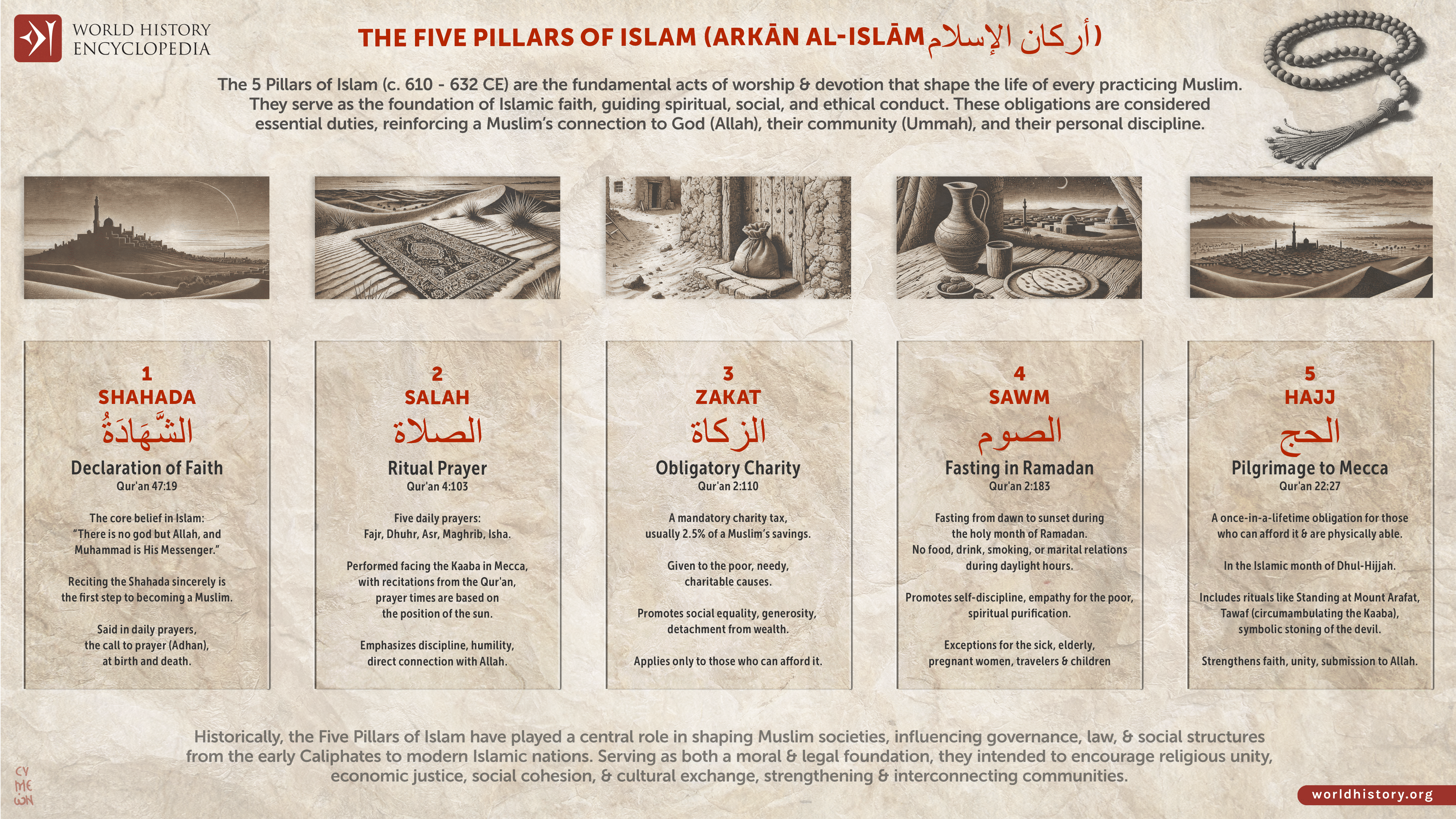
The Five Pillars of Islam (Arkan al-Islam)

The Five Pillars of Islam, established during the lifetime of the Prophet Muhammad (c. 570–632 CE), form the foundational framework of Islamic faith and practice. They comprise Shahada (faith), Salah (prayer), Zakat (charity), Sawm (fasting), and Hajj (pilgrimage). Emerging in 7th-century Arabia, these core obligations reflected and restructured earlier Abrahamic and regional devotional traditions into a unified system. The Shahada affirmed monotheism and the finality of Muhammad’s prophethood; Salah codified daily prayer; Zakat institutionalized almsgiving as a moral duty; Sawm during Ramadan cultivated spiritual discipline; and Hajj sanctified the pilgrimage to Mecca, redirecting pre-Islamic rituals toward monotheistic worship.
As Islam expanded across Asia, Africa, and Europe, the Five Pillars provided a common framework of belief and practice that transcended ethnic, linguistic, and political boundaries. They shaped the moral and legal foundations of Muslim societies through the sharia (Islamic law) and informed daily life, governance, and expressions of communal identity. By uniting spiritual devotion with social responsibility, the Five Pillars became not only personal obligations but also a blueprint for Islamic civilization’s enduring cohesion and ethical order.