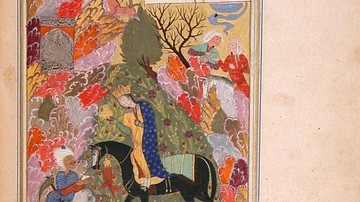
Persian Poets and Literature

Celebrate Our Anniversary with Trivia!

Join us on August 23 for a free virtual trivia party featuring questions about ancient civilizations, U.S. history, unusual historical facts, pop culture, and more.

$633 / $5000
Joshua J. Mark
by
published on
bookmark_addbookmark_addedSave Collection

Persian literature is usually dated to the Behistun Inscription of Darius I (the Great, r. 522-486 BCE) at c. 522 BCE. It is generally understood that a significant body of work was created by Persian writers between that time and c. 330 BCE when Alexander the Great destroyed the library at Persepolis when he set fire to the city.

Many scholars, therefore, claim there is no “Persian Literature” prior to the Sassanian Empire (224-651) or date its beginnings to c. 750 with the rise of the Abbasid Dynasty whose poets preserved ancient tales from pre-Islamic Iran. Those who date Persian literature to the Sassanian Period cite the reign of Shapur I (240-270) as its inception as he encouraged literacy by having the Avesta, previously an oral text, committed to writing.

Although “literature” is commonly understood to refer to works of the imagination, Persian literature includes scripture, medical treatises, histories, and many other kinds of writings. A religious text like the Avesta, included below, might not be defined as “literature” in another culture but is regarded as such in Persian literature owing to its literary style and lyricism.

Articles & Definitions

Persian Literature
Definition

Persian Literature

Persian literature differs from the common definition of “literature” in that it is not confined to lyrical compositions, to...
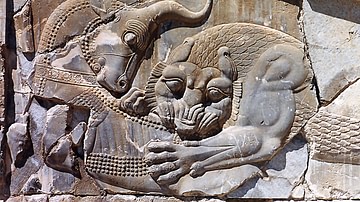
Behistun Inscription
Definition

Behistun Inscription

The Behistun Inscription is a relief with accompanying text carved 330 feet (100 meters) up a cliff in Kermanshah Province...
Avesta
Definition

Avesta

The Avesta is the scripture of Zoroastrianism which developed from an oral tradition founded by the prophet Zoroaster (Zarathustra, Zartosht...
Twelve Ancient Persian Mythological Creatures
Article

Twelve Ancient Persian Mythological Creatures

The mythology of any civilization reflects its core values, greatest fears, and highest hopes and so it...
Nasta 'liq
Definition

Nasta 'liq

Nasta 'liq is one of the styles of Islamic calligraphy that was developed on Persian grounds by Persian calligraphers. The art of...
Ten Great Persian Poets
Article

Ten Great Persian Poets

Persian literature derives from a long oral tradition of poetic storytelling. The first recorded example of this tradition...
Omar Khayyam
Definition

Omar Khayyam

Omar Khayyam (also given as Umar Khayyam, l. 1048-1131 CE) was a Persian polymath, astronomer, mathematician, and philosopher but...
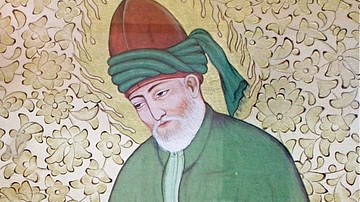
Rumi
Definition

Rumi

Jalal ad-Din Muhammad Rumi (also given as Jalal ad-did Muhammad Balkhi, best known as Rumi, l. 1207-1273 CE) was a Persian Islamic theologian...
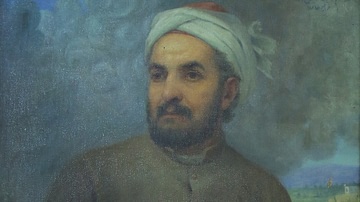
Hafez Shiraz
Definition

Hafez Shiraz

Hafez of Shiraz (also given as Hafiz, l. 1315-1390) is considered the greatest of the Persian poets and among the most famous and...
Khamsa of Nizami
Definition

Khamsa of Nizami

Khamsa (also known as Quintet or Panj Ganj) is the best-known work of Nizami Ganjavi (c. 1141-1209 CE) and without a doubt one...
Ferdowsi
Definition

Ferdowsi

Abolqasem Ferdowsi (l. c. 940-1020 CE, also given as Abul-Qasem Ferdowsi Tusi, Firdawsi, Firdausi) is the author of the Shahnameh (The...
Shahnameh
Definition

Shahnameh

The Shahnameh (“Book of Kings”, composed 977-1010 CE) is a medieval epic written by the poet Abolqasem Ferdowsi (l. c. 940-1020 CE...

Illustrations

Questions & Answers

When is Persian Literature dated to?

Persian Literature is commonly dated to the Behistun Inscription of c. 522 BCE.

When was Persian Literature destroyed?

Persian literary works written between c. 522 BCE and c. 330 BCE were destroyed when Alexander the Great burned the city of Persepolis in 330 BCE, including the great library.

Who is the greatest Persian Poet?

Hafez Shiraz (l. 1315-1390 CE) is generally considered the greatest Persian poet of all time, though there are other contenders for the honor.

What is the greatest work of Persian literature?

The Shahnameh by Ferdowsi, written between 977-1010 CE, is considered the greatest work of Persian literature.
Subscribe to this author

About the Author

Free for the World, Supported by You

World History Encyclopedia is a non-profit organization. Please support free history education for millions of learners worldwide for only $5 per month by becoming a member. Thank you!

World History Encyclopedia is a non-profit organization. Please support free history education for millions of learners worldwide for only $5 per month by becoming a member. Thank you!

Become a Member  

Support Us Remove Ads