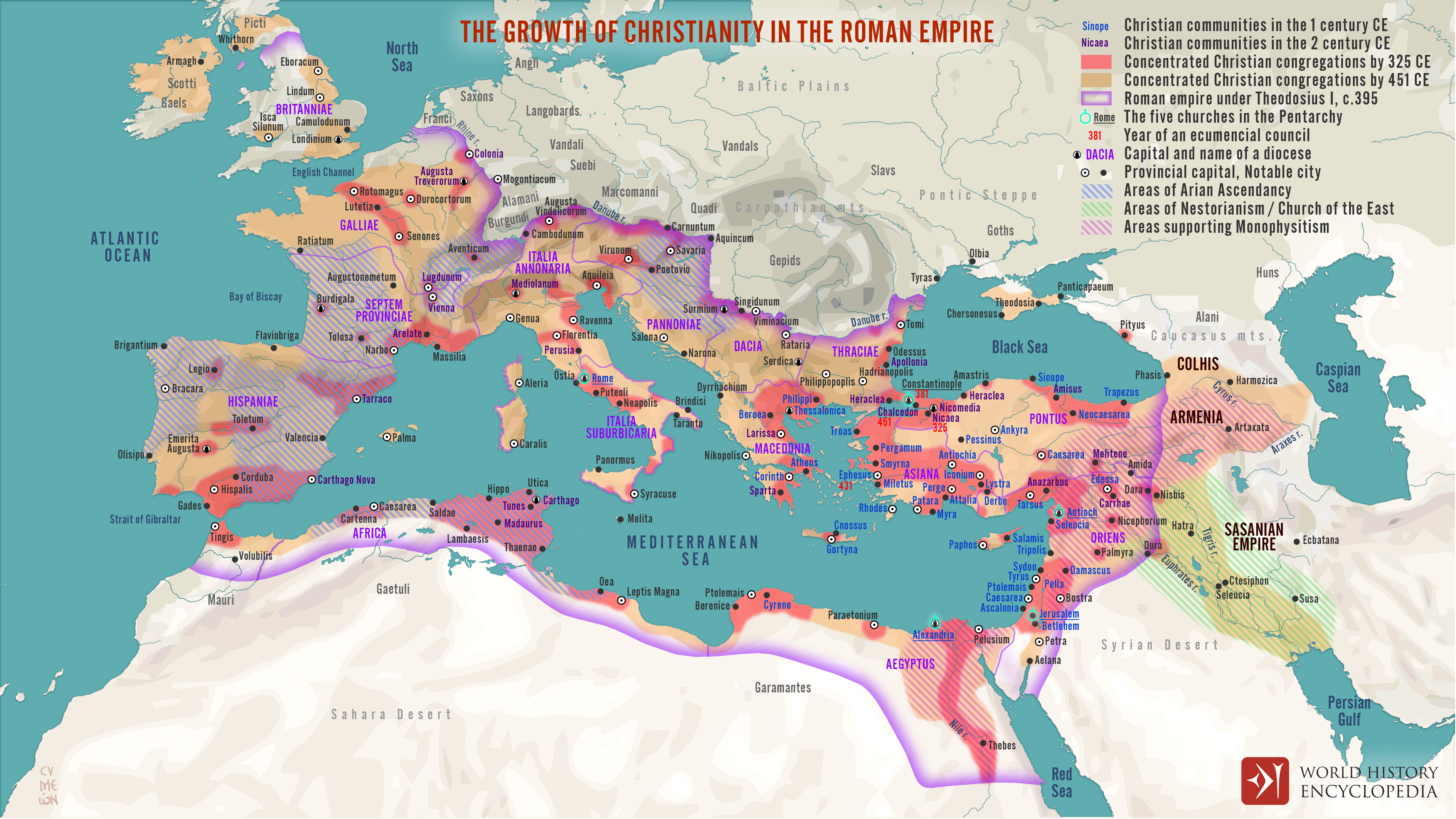
Map of the Growth of Christianity in the Roman Empire

The rise and spread of Christianity (1st–5th centuries CE) traces the transformation of a small, decentralized religious movement in Roman Judea into a faith that reshaped the political, social, and cultural foundations of the Roman world. Emerging in the mid-1st century CE within a Jewish context, early Christianity spread primarily through urban networks of the eastern Mediterranean, aided by Roman roads, shared languages, and diasporic communities. Periods of persecution alternated with tolerance, but the religion’s emphasis on universal salvation, community, and moral order allowed it to take root across diverse social groups, from enslaved people to imperial elites.
A decisive shift occurred under Constantine the Great (reign 306–337 CE), whose patronage culminated in the Council of Nicaea (325 CE), an effort to impose doctrinal unity through the Nicene Creed. Christianity’s institutional authority was further consolidated under Theodosius I the Great (reign 379–395 CE), when the Edict of Thessalonica (380 CE) established Nicene Christianity as the empire’s official religion. Yet this process also intensified theological conflict. Councils such as Chalcedon (451 CE) sought to define Christ’s nature, while divergent interpretations, later labeled heretical, including Arianism, Nestorianism, and Monophysitism, spread widely across the empire and beyond. Rather than a simple story of triumph, early Christianity’s expansion reveals a complex interplay of belief, power, debate, and imperial authority that shaped both religious orthodoxy and enduring divisions within the Christian world.