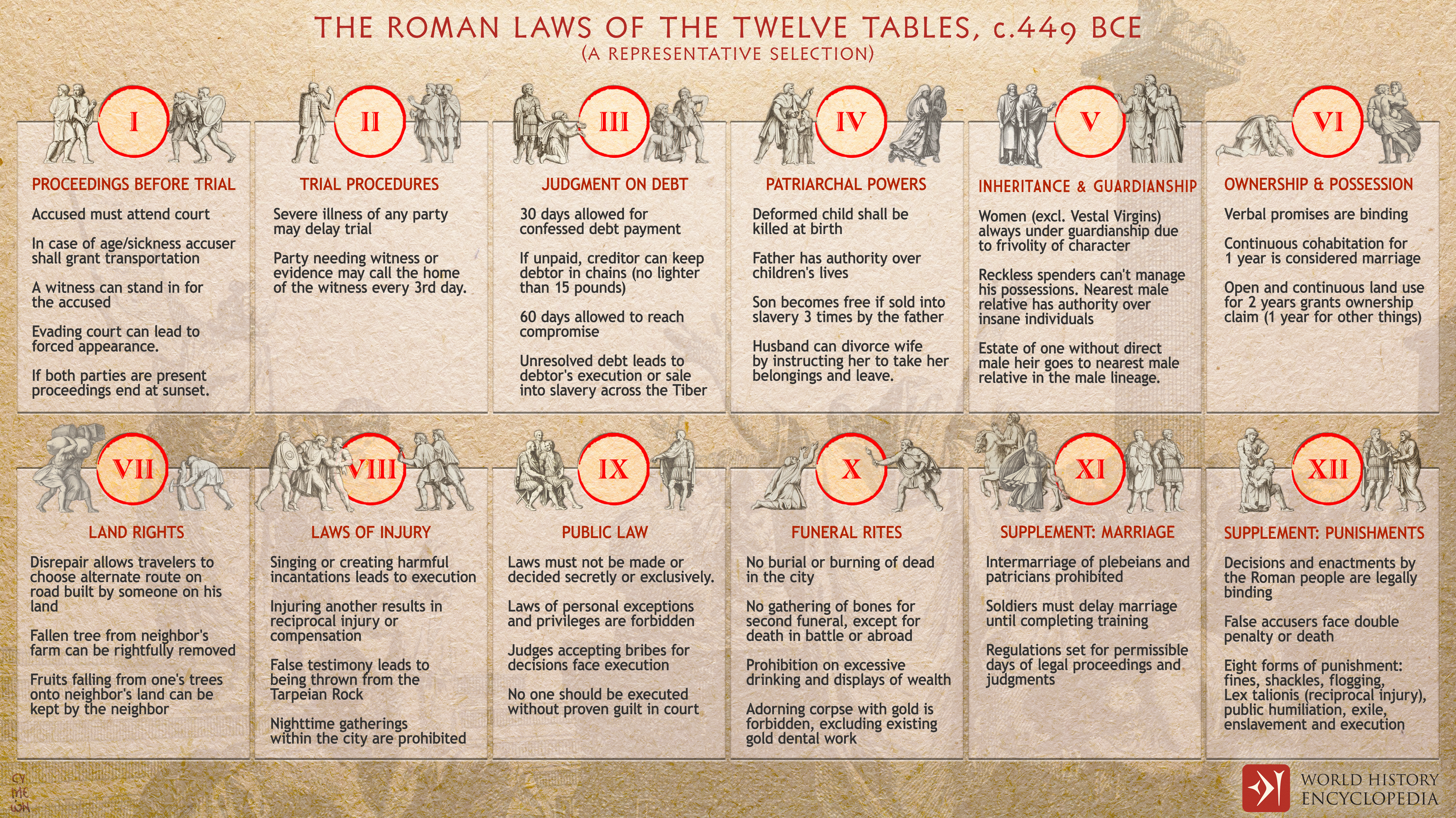
The Laws of the Twelve Tables (c. 451–450 BCE) represent the earliest surviving codification of Roman law during the early Roman Republic (traditionally founded 509 BCE). Drafted by a special commission of ten magistrates (decemviri) amid the Conflict of the Orders between patricians and plebeians, the code was publicly inscribed and displayed in the Forum. Its publication marked a decisive shift from customary, aristocratically interpreted law to written statutes accessible to the citizen body. By formalizing procedures concerning property rights, family authority, inheritance, and civil litigation, the Twelve Tables established a shared legal framework intended to limit arbitrary judicial power and promote procedural clarity.
Compiled in response to plebeian demands for transparency and predictable justice, the code addressed issues ranging from debt bondage and contracts to guardianship, burial practices, and criminal penalties. While reflecting the social hierarchies and harsh sanctions of the 5th century BCE, it nonetheless introduced the principle that law derived from publicly recognized rules rather than private elite interpretation. Over subsequent centuries, Roman jurists expanded and refined this foundation, but the Twelve Tables retained symbolic authority as the bedrock of Roman jurisprudence. Their legacy, particularly the emphasis on written law, civic rights, and due process, profoundly influenced later Roman legal development and, indirectly, the evolution of Western legal traditions.