17 Campaigns & Battles of Napoleon

Celebrate Our Anniversary with Trivia!

Join us on August 23 for a free virtual trivia party featuring questions about ancient civilizations, U.S. history, unusual historical facts, pop culture, and more.

$543 / $5000
Harrison W. Mark
by
published on
bookmark_addbookmark_addedSave Collection

Napoleon Bonaparte (1769-1821), Emperor of the French, was one of the most successful military commanders of the modern era. From relatively humble beginnings, he rose to prominence during the tumultuous wars of the French Revolution, ultimately fighting in over 60 battles, of which he lost only seven. His conquests expanded his empire to the borders of Europe.

Born to a family of minor Corsican nobility a year after Corsica was acquired by France, Napoleon recieved an education in French military academies and joined the army as an artillery officer. He supported the French Revolution when it began in 1789, and helped the revolutionary government reclaim the port city of Toulon after it had been captured by counter-revolutionary rebels and Coalition troops; his actions at the Siege of Toulon in 1793 earned him the rank of brigadier general, aged only 24, and began his illustrious career. He would go on to suppress a royalist rebellion in Paris in 1795 before leading the French on campaigns in Italy and Egypt. His popularity would grow to such heights to allow him, in 1799, to seize control of France in the Coup of 18 Brumaire.

At the height of the First French Empire in 1810, Napoleon's influence stretched from the Iberian Peninsula to Poland.

Thus ended the revolutionary period, ushering in a new era: the Napoleonic. In the decade after the Coronation of Napoleon I as Emperor of the French in 1804, Napoleon would lead his Grande Armée on several brilliant campaigns against his European enemies, which often included Great Britain, Austria, Prussia, or Russia at the head of a European coalition (there were ultimately seven). At the height of the First French Empire in 1810, Napoleon's influence stretched from the Iberian Peninsula to Poland. Yet a series of setbacks in Spain and Russia would see Napoleon's empire unravel by 1812. He was forced to abdicate in 1814 only to make a triumphant return to France the following year; defeated by the Duke of Wellington at Waterloo in 1815, he was finally exiled to St. Helena, the lonely South Atlantic island where he would die in 1821.

This collection contains each of the campaigns in which Napoleon fought during his 22-year-long military career, as well as several handpicked battles in which he commanded. Through these 17 key campaigns and battles, one can trace the meteoric rise and resounding fall of one of history's most well-known and controversial leaders.

Articles & Definitions

Siege of Toulon
Article

Siege of Toulon

The Siege of Toulon (29 August to 19 December 1793) was a decisive military operation during the French Revolutionary Wars (1792-1802...
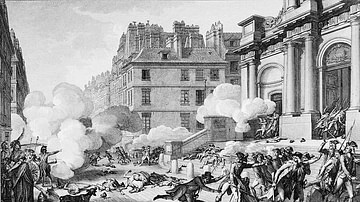
13 Vendémiaire
Definition

13 Vendémiaire

The Revolt of 13 Vendémiaire Year IV (5 October 1795) was a royalist uprising in Paris during the French Revolution (1789-1799...
Napoleon's Italian Campaign
Definition

Napoleon's Italian Campaign

The Italian campaign of 1796-1797, waged by a young Napoleon Bonaparte, was a decisive campaign in the French Revolutionary...
Napoleon's Campaign in Egypt and Syria
Definition

Napoleon's Campaign in Egypt and Syria

The French Expedition to Egypt and Syria (1798-1801), led by Napoleon Bonaparte, aimed to establish a French...
War of the Third Coalition
Definition

War of the Third Coalition

The War of the Third Coalition (1805-1806) was a major European conflict during the Napoleonic Wars (1803-1815). It was...
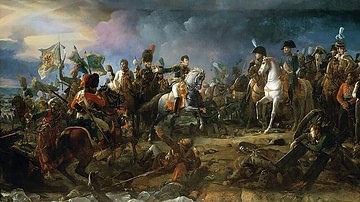
Battle of Austerlitz
Article

Battle of Austerlitz

The Battle of Austerlitz (2 December 1805), or the Battle of the Three Emperors, was one of the most significant battles of...
War of the Fourth Coalition
Definition

War of the Fourth Coalition

The War of the Fourth Coalition (October 1806 to June 1807) was a major conflict during the Napoleonic Wars (1803-1815...
Battle of Jena-Auerstedt
Article

Battle of Jena-Auerstedt

The twin battles of Jena and Auerstedt, both fought on 14 October 1806, marked a major turning point in the Napoleonic...
War of the Fifth Coalition
Definition

War of the Fifth Coalition

The War of the Fifth Coalition (1809) was a major conflict of the Napoleonic Wars (1803-1815) that was fought primarily...
Battle of Wagram
Article

Battle of Wagram

The Battle of Wagram (5-6 July 1809) was one of the largest and bloodiest battles of the Napoleonic Wars (1803-1815). It resulted...
Peninsular War
Definition

Peninsular War

The Peninsular War (1807-1814), also known as the War of Spanish Independence, was a major conflict of the Napoleonic Wars (1803-1815...
Napoleon's Invasion of Russia
Definition

Napoleon's Invasion of Russia

Napoleon's invasion of Russia, also known as the Second Polish War or, in Russia, as the Patriotic War of 1812, was...
Battle of Borodino
Article

Battle of Borodino

The Battle of Borodino (7 September 1812) was a major battle fought during Napoleon's invasion of Russia. It saw the French...
War of the Sixth Coalition
Definition

War of the Sixth Coalition

The War of the Sixth Coalition (1813-1814), known in Germany as the Wars of Liberation, was the penultimate conflict of...
Battle of Leipzig
Article

Battle of Leipzig

The Battle of Leipzig (16-19 October 1813), or the Battle of the Nations, was the largest battle of the Napoleonic Wars (1803-1815...
Hundred Days
Definition

Hundred Days

The Hundred Days refers to the second reign of French Emperor Napoleon I, who unexpectedly returned from exile to reclaim the French...
Battle of Waterloo
Article

Battle of Waterloo

The Battle of Waterloo (18 June 1815) was the last major engagement of the Napoleonic Wars (1803-1815), fought by a French army...

Illustrations

Questions & Answers

How many battles did Napoleon Bonaparte participate in?

Napoleon Bonaparte fought in or commanded approximately 60 battles over the course of his career, and only lost seven.

What were some military innovations made by Napoleon?

Napoleon's armies were known for their speed and ability to live off the land, made possible by his use of the corps d'armee system, whereby his armies were subdivided into semi-autonomous corps that could march independently but fight together when necessary.

When did Napoleon abdicate?

Napoleon abdicated for the first time on 11 April 1814. Afterward he returned to France and was defeated at the Battle of Waterloo, after which he abdicated for a second time on 22 June 1815.
Subscribe to this author

About the Author

Free for the World, Supported by You

World History Encyclopedia is a non-profit organization. Please support free history education for millions of learners worldwide for only $5 per month by becoming a member. Thank you!

World History Encyclopedia is a non-profit organization. Please support free history education for millions of learners worldwide for only $5 per month by becoming a member. Thank you!

Become a Member  

Support Us Remove Ads