
Search
Remove Ads
Advertisement

 This answer was generated by
 Search Results

Definition
Baal
Baal (also given as Ba'al) is a Canaanite-Phoenician god of fertility and weather, specifically rainstorms. The name was also used as a title, however, meaning "Lord" and was applied to a number of different deities throughout the ancient...

Image
Baal Cycle Tablets
Clay tablets engraved with cuneiform script preserving the Ugaritic poem known as the Baal Cycle, a story featuring gods from Canaanite-Phoenician religion. The Baal Cycle tells the story of the sea god Yamm's conflict with the fertility...

Definition
Yamm
Yamm (from the Semitic word yam for 'sea', also known as Yam and Yam-Nahar) was the god of the sea and storm in the pantheon of the Canaanite-Phoenicians. Depicted consistently as tyrannical, angry, violent, and harsh, Yamm was the brother...

Definition
Astarte
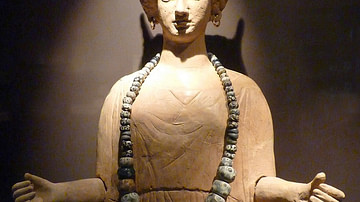
Astarte is the Canaanite/Phoenician goddess of love, sex, war, and hunting who developed from the Mesopotamian deity Inanna/Ishtar. She is usually associated with the storm god Baal but seems to have been much more popular. She traveled to...
Definition
Carthaginian Religion
Carthage was founded by the Phoenician city of Tyre in the 9th century BCE, and along with many other cultural practices, the city adopted aspects of the religion of its founding fathers. Polytheistic in nature, such important Phoenician...

Article
The Aftermath of Looting: Illegally Excavated Mesopotamian Tablets
He who saw everything in the broad-boned earth, and knew what was to be known, Who had experienced what there was, and had become familiar with all things. The Epic of Gilgamesh. The tornado has started After the US-led invasion of...
Definition
Arslan Tash Amulet
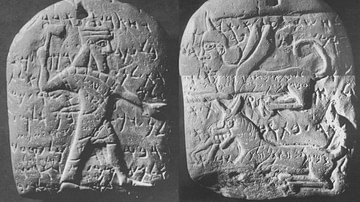
Dated to the 7th century BCE, the Arslan Tash amulet (AT1) was discovered in Arslan Tash, Syria and contains the writing of Phoenician, magic incantations. The limestone plaque includes a variety of features: incantations perceived to prevent...

Definition
Gideon
Gideon was a judge and military leader, whose story was recounted in the Biblical Book of Judges. “Judge” (Hebrew, shofet) in this book was not a circuit, court judge, but someone raised up by the God of Israel during a crisis. It is equivalent...

Definition
Linear B Script
Linear B script was the writing system of the Mycenaean civilization of the Bronze Age Mediterranean. The syllabic script was used to write Mycenaean Greek from c. 1500 to c. 1200 BCE. It was deciphered by Michael Ventris in 1952, and so...

Article
The Athenian Calendar
The term “Athenian Calendar” (also called the “Attic Calendar”) has become somewhat of a misnomer, since Ancient Athenians never really used just one method to reckon the passage of time. Athenians, especially from the 3rd Century BCE forward...
