



Patrick R. Cleburne (1828-1864) was an Irish-born Confederate general during the American Civil War (1861-1865). Having immigrated to Arkansas in 1850, Cleburne fell in love with his adopted state and volunteered to fight for the Confederate States in 1861. He fought in several significant campaigns in the western theater of the war and steadily rose through the ranks to become a major general. Regarded as one of the most competent division commanders on either side of the conflict, he was respected by his men and earned the nickname 'Stonewall of the West'. Cleburne was killed at the Battle of Franklin (30 November 1864) while leading his troops in a futile charge that he had opposed.
Early Life
Patrick Ronayne Cleburne was born on 17 March 1828 – St. Patrick's Day – in County Cork, Ireland. The third child of a moderately successful physician, Cleburne's childhood was beset with tragedy; his mother died only 19 months after giving birth to him, and his father died in November 1843, leaving young Patrick an orphan at 15. Forced by these circumstances to grow up before his time, Cleburne dropped out of school so that he could find work and help provide for his siblings. He dreamt of following his father's footsteps and embarking on a medical career. However, these ambitions were crushed when he was twice rejected by a Dublin medical school. In February 1846, with few other prospects available to him, he enlisted in the 41st Regiment of Foot in the British Army.
Cleburne was assigned to Fort Westmoreland on Spike Island in Cork Harbour, a large fortress that was being used as a prison. Although he quickly rose to the rank of corporal, Cleburne soon found himself disillusioned with the harshness and tedium of life in the British Army. Prolonged guard duty in freezing temperatures left him with rheumatism and resulted in a two-month hospital stay. Additionally, Cleburne was disgusted by the fact that many of the convicts imprisoned in Fort Westmoreland were fellow Irishmen, arrested for stealing food during the Great Famine (aka the Irish Potato Famine). By 1847, the fort had become one of the biggest prisons in the British Empire and was later dubbed the 'Irish Alcatraz'. Cleburne must have felt a tinge of guilt watching his malnourished countrymen get shoved into its crowded cells for the crime of wanting to feed their families. For these reasons, Cleburne bought his discharge and left the army in 1849. With nothing left for him in the British Isles, he pooled his resources with two of his brothers and a sister and left Ireland forever, bound for a new life in the United States.
Immigration to Arkansas
Cleburne arrived in America on Christmas Eve 1849, stepping off the boat in New Orleans. After spending a few months in Ohio, he ultimately settled in Helena, Arkansas, in 1850, where he found work as a clerk in a drugstore. Initially, Cleburne felt like an outsider. A naturally shy and awkward man, he embarrassed himself at a dance shortly after coming to town, his clumsy movements making him a laughingstock for a short while. Additionally, his way of speaking betrayed his lack of education, while his thick Irish accent betrayed his foreign birth. But even then, Cleburne was not a man to accept defeat. He worked tirelessly to perfect his dancing skills, taking lessons in the evenings until he was as graceful on the dance floor as anyone else in Helena. He also worked on his speech and was soon eloquent enough to be accepted as a member of the local debate society. Cleburne applied this fierce determination to every aspect of his life. In one instance, after being dumped from his saddle by a stubborn horse, he resolved to become a master horseman and spent weeks riding around the fields outside of town until he had achieved that goal.
The citizens of Helena found that they could not help but love this strange Irishman who was determined to be perfect at everything he did. Before long, he was accepted by them and was considered a valued member of the community. By 1853, he had been elected leader of his masonic lodge and had purchased an interest in the drugstore where he worked. A year later, he sold his ownership in the drugstore and turned his tireless energy toward the study of law. In January 1856, he passed the Arkansas bar and set up a law practice, cementing his status and popularity with the locals. This did not mean he was without enemies, however. In May 1856, he and his close friend, Thomas C. Hindman, got into a politically fueled quarrel with adherents of the nativist Know-Nothing Party. Their argument soon turned violent, and shots were fired. A bullet, probably meant for Hindman, hit Cleburne in the back, lodging near his lungs. Cleburne turned and fired, mortally wounding one of his assailants, before falling. He was carried back to the drugstore, where he lay in critical condition for a week before he slowly began to recover.

Fighting for the South
As Cleburne assimilated into his Arkansas community, the United States was being riven along sectional lines. The issue of slavery, as well as other constitutional questions such as that of states' rights, had pitted the 'free states' of the North against the 'slave states' of the South. After the election of President Abraham Lincoln (1809-1865) and the antislavery Republican Party in 1860, several Southern states voted to secede from the Union and form a new nation, the Confederate States of America. In January 1861, even before Arkansas had formally seceded, Cleburne enlisted in a local militia company, the Yell Rifles, as a private. He did not do so out of any desire to preserve slavery – which he claimed not to care much about one way or the other – but rather to fight alongside his adopted countrymen, who had welcomed him into their lives. He told his brother Robert that he was "with Arkansas in weal or in woe" and "with the South in life or death, in victory or defeat" (quoted in Sword, 16). Before leaving for the front, he was gifted a Bible by his friends, a gesture that left him choked with emotion and unable to speak.
He proved just as popular in the militia as he had been in Helena, and, when his company was incorporated into the 1st Arkansas Regiment in May 1861, he was elected colonel by his comrades. By the spring of the following year, he was a brigadier general in command of one of the three brigades in the corps of Major General William J. Hardee. Hardee's corps, in turn, was part of the Confederate Army of Mississippi under General Albert Sidney Johnston (1803-1862), who was gearing up for a counteroffensive to retake Tennessee, much of which had recently been lost to Union forces. Johnston's campaign culminated in the bloody Battle of Shiloh (6-7 April 1862), where Cleburne's brigade helped spearhead the assault on the unsuspecting right wing of the Union army. During the initial charge, Cleburne was thrown from his horse and landed in a swamp. He swiftly rose and, covered in mud, continued leading his men forward against the enemy lines. Before the battle was done, Cleburne's men would suffer more losses than any other brigade in the army; having started the fight with 2,750 men, Cleburne would leave it with over 1,000 men lying dead or wounded on the field.

Despite the initial success of the Confederate assault, the death of Johnston and the arrival of Union reinforcements turned the tide against them, and they were defeated. After Shiloh, the battered Confederate army withdrew to Corinth, Mississippi, where it remained for a month before abandoning the town in the face of the oncoming Yankee horde. A few months later, Cleburne's brigade was transferred to the Army of Tennessee under the command of General Braxton Bragg (1817-1879) who was planning an invasion of Union-controlled Kentucky. Cleburne's brigade was part of the advance element of Bragg's invasion, clashing with a Union force outside Richmond, Kentucky, on 30 August 1862. During the battle, Cleburne had leaned over to talk with a wounded colonel when a bullet pierced his left cheek, knocked out two of his teeth, and lodged in his mouth. Though he would recover, Cleburne thereafter always wore a mustache and goatee to hide the scar. He was back in command of his brigade in time for the climactic Battle of Perryville (8 October 1862) where he was again wounded when a piece of shrapnel struck his ankle. Though Perryville was a tactical Confederate victory, Bragg had lost so many men that he was forced to call off the invasion, leaving Kentucky in Northern hands.
Stonewall of the West
In December 1862, Cleburne was promoted to major general, apparently at the urging of Confederate President Jefferson Davis (1808-1889), who had visited the Army of Tennessee and come away impressed with the young Irishman's abilities. Cleburne's skills as a division commander would soon be put to the test at the Battle of Stones' River (aka Murfreesboro; 31 December to 2 January). During this engagement, his division marched three miles before routing the Union right wing, pushing all the way to the enemy's final line of defense. While Cleburne was celebrated for this success, Bragg had once again sustained too many losses and ordered a withdrawal. Cleburne and several other staff officers accused Bragg of causing the defeat through his mismanagement of the army, leading to the rise of opposing cliques within the command structure of the Army of Tennessee.
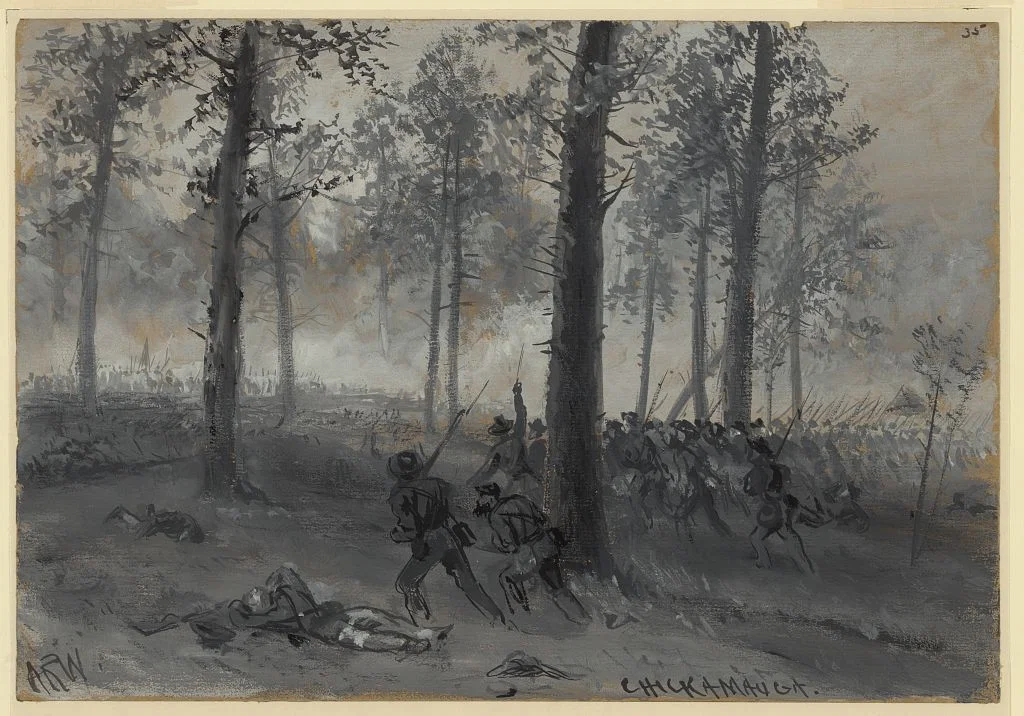
At the Battle of Chickamauga (19-20 September 1863), Cleburne's division helped anchor the Confederate right wing. At sunset on the first day of fighting, he led his troops in a spirited charge against a Union division under Major General George H. Thomas (1816-1870). Thomas, taken off guard by the aggression of Cleburne's assault, struggled to hold his ground and was forced to repeatedly ask for reinforcements. By nightfall, Cleburne had gained ground but at a high cost, having lost 30% of his men. The next morning, at 9 a.m., Cleburne and Major General John C. Breckenridge coordinated assaults against the Union line, with Cleburne's men encountering stiff resistance at the Yankee breastworks. Although their assault had petered out by noon, it succeeded in causing confusion in the Union lines and helped contribute to the ultimate Confederate victory. After Chickamauga, the Union army retreated to Chattanooga, Tennessee, with Bragg in pursuit.
Bragg set his forces up on the high ground outside the city, leading to the Battle of Chattanooga (25 November 1863), when Union forces under Major General William Tecumseh Sherman (1820-1891) assaulted the strong Confederate positions. Cleburne led one of three divisions entrenched on Missionary Ridge, and withstood wave after wave of Union assault. Eventually, the rebels were driven off the ridge, but Cleburne's men engaged in a fighting retreat, covering the withdrawal of the Confederate guns and supplies. Cleburne and many of his fellow officers once again blamed Bragg for the defeat at Chattanooga and petitioned for his removal; Bragg resigned his command in December 1863, although the hierarchy of the Army of Tennessee remained plagued with factionalism. Unlike Bragg, Cleburne was idolized by his men, who said they would follow him to hell and back. He was widely regarded as the best division commander in any Confederate army. His aggressive style of leadership and staunch ability to withstand enemy assaults were reminiscent of another Confederate general, the fallen Stonewall Jackson (1824-1863), earning Cleburne the nickname 'Stonewall of the West'.
Proposal for Enlisting Black Soldiers
By the end of 1863, it was already clear that the Southern Confederacy was in dire straits. In the east, General Robert E. Lee (1807-1870) and his seemingly invincible Army of Northern Virginia had been defeated at Gettysburg, while the fall of Vicksburg, Mississippi, had effectively cut the Confederate States in twain. In addition to these battlefield defeats, the South was running worryingly low on manpower. While the North could theoretically field as many as 3 million men, the South could count on a little over a million; on the actual muster rolls, the South had 481,000 men in the field, against a total of 860,000 men in the Federal armies. A final problem was that the Confederacy desperately needed recognition from European nations, like Britain and France. But ever since Lincoln's Emancipation Proclamation had framed the war as a fight over the future of slavery, the prospect of support from any major foreign power had grown significantly dimmer.
Cleburne, who of course had never been attached to slavery, believed that this 'peculiar institution' should be sacrificed to preserve Southern independence. On 2 January 1864, he approached his fellow officers of the Army of Tennessee with a radical proposal – the South should allow Black men to enlist in the Confederate Army as soldiers, and that freedom should be offered to any slave who remained loyal to the Confederacy. Arguing that his proposal was a "concession to common sense," Cleburne stated that slavery was the Confederacy's "most vulnerable point, a continued embarrassment," and that by enlisting Black soldiers, they could boost their manpower while weakening the argument that they were solely fighting for the preservation of slavery. Naturally, this proposal was hotly debated by the officers of the Army of Tennessee. It was forwarded to the desk of President Davis, who viewed it with alarm. Not only did Davis dismiss the proposal out of hand, but he ordered its suppression so that the public would never find out.

Final Campaigns & Death
In the spring of 1864, Cleburne became engaged to Susan Tarleton, a young woman from Mobile, Alabama. Having made plans to marry her after the coming campaign season, he returned to the Army of Tennessee as it moved into Georgia to defend the city of Atlanta. During the ensuing Atlanta Campaign (May to September 1864), Cleburne's division took part in several skirmishes as the army withdrew eastward. They were unable to save the city, however. On 2 September, the Army of Tennessee – now commanded by General John Bell Hood (1831-1879) – abandoned Atlanta, which was occupied by Union forces under Sherman. The fall of Atlanta was one of the major death knells of the Confederacy, contributing to the re-election of Lincoln and killing any Southern hope of negotiating peace with a potential successor.
After capturing Atlanta, Sherman began planning his campaign through Georgia that would become immortalized as his March to the Sea. Rather than follow, General Hood opted to march the other way and invade Union-controlled Tennessee, hoping that, by doing so, he could lure Sherman out of Georgia. Sherman, however, did not take the bait, instead tasking General Thomas with Hood's destruction. Thus began the Franklin-Nashville Campaign (September to December 1864), the last, desperate military operation carried out by the beleaguered Army of Tennessee. At the Battle of Spring Hill (29 November 1864), Hood attacked a Union army under Major General John Schofield as it marched to link up with Thomas at Nashville. Hood, however, was unable to land a decisive blow, allowing Schofield to withdraw to the town of Franklin, where he set up strong defensive positions. Hood followed and, on 30 November, decided to attack, overriding the objections of his officers, including Cleburne, who believed a frontal assault to be borderline suicidal.

At the Battle of Franklin, six Confederate divisions numbering about 20,000 men in all surged forward toward the Union defenses. Cleburne spurred his men onward from horseback; once his horse had been shot out from under him, he led them forward on foot, shouting encouragement and waving his sword in the air. This was the last time anyone would see him alive. When the smoke cleared, his corpse was found just inside the Union breastworks. He had been killed by a bullet to the abdomen, and by the time his body had been found, it had already been stripped of its valuables. Cleburne was one of six Confederate generals to have been killed or mortally wounded at Franklin, with 6,000 other Confederate soldiers also becoming casualties. Franklin was one of the worst Confederate defeats of the war. Afterward, Hood would suffer further defeat at the Battle of Nashville (15 December), and the Army of Tennessee, with which Cleburne had served for so many battles, ceased to exist. After the war, in 1870, Cleburne's remains were interred in his beloved adopted hometown of Helena, Arkansas.


