
Search
Did you mean: Saga?
Remove Ads
Advertisement

 This answer was generated by
 Search Results
Image
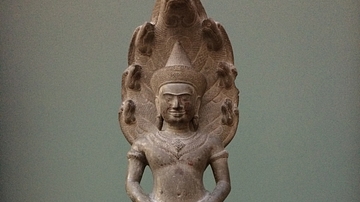
Buddha & Naga
A limestone figure of a seated Buddha protected by Naga. Preah Khan Kompong Svay, Cambodia. 12th century CE. (Musée Guimet, Paris)

Definition
Nisaba - Sumerian Goddess of Writing and Scribe of the Gods
Nisaba (also Naga, Se-Naga, Nissaba, Nidaba, and associated with Nanibgal) is the Sumerian goddess of writing, accounts, and scribe of the gods. Although her name is commonly given as Nidaba...

Article
The Ajanta Caves
The 30 caves at Ajanta lie to the north of Aurangabad in the Indhyadri range of Western Ghats. The caves, famous for their temple architecture and many delicately drawn murals, are located in a 76 m high, horseshoe-shaped escarpment...
Article
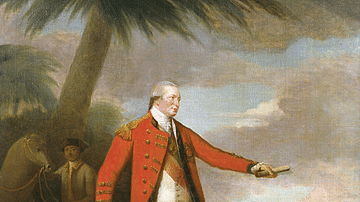
Battle of Buxar
The Battle of Buxar (aka Bhaksar or Baksar) in Bihar, northeast India, on 22-23 October 1764 saw a British East India Company (EIC) army led by Hector Munro (1726-1805) gain victory against the combined forces of the Nawab of...

Article
Hymn to Nisaba - A Praise Song for the Sumerian Goddess of Writing
The Hymn to Nisaba (circa 3rd millennium BCE) is a poem praising Nisaba, the Sumerian goddess of writing and accounts who also served as scribe of the gods. The poem is officially dedicated...

Definition
Meroë
Meroe was a wealthy metropolis of the ancient kingdom of Kush in what is today the Republic of Sudan. It was the later capital of the Kingdom of Kush (c. 1069 BCE to c. 350 CE) after the earlier capital of Napata was sacked c. 590 BCE...
Definition
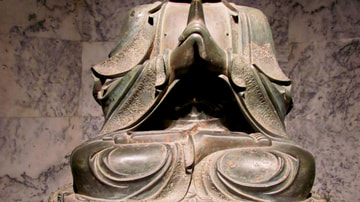
Esoteric Buddhism
Esoteric Buddhism is the mystical interpretation and practice of the belief system founded by the Buddha (known as Sakyamuni Buddha, l. c. 563 - c. 483 BCE). It is known by several names and is characterized by a personal relationship...

Definition
Chandragupta II
Chandragupta II (c. 375 CE - 413/14 CE) was the next great Gupta emperor after his father Samudragupta (335/350 - 370/380 CE). He proved to be an able ruler and conqueror with many achievements to his credit. He came to be known...

Article
Cultural Links between India & the Greco-Roman World
Cyrus the Great (558-530 BCE) built the first universal empire, stretching from Greece to the Indus River. This was the famous Achaemenid Empire of Persia. An inscription at Naqsh-i-Rustam, the tomb...

Article
Rock Art History of Madhya Pradesh: Adamgarh & Nagori
Rock art, that is paintings and carvings on natural rock formations, is one of the earliest forms of creative expression and a universal phenomenon among prehistoric societies. An instrument of communication...
