
Search
Remove Ads
Advertisement

 This answer was generated by
Search Results

Definition
Diocletian
Diocletian was Roman emperor from 284 to 305 CE. After the defeat and death of the Roman emperor Philip the Arab in 249 CE, the empire endured over three decades of ineffective rulers. The glory days of Augustus, Vespasian, and Trajan...

Image
Basement halls of Diocletian's Palace
The basement halls of Diocletian's Palace were originally the supporting structures of the Roman emperor's residential quarters. They reflect the layout of the upper floor halls. Diocletian's Palace (Split, Croatia...
Image
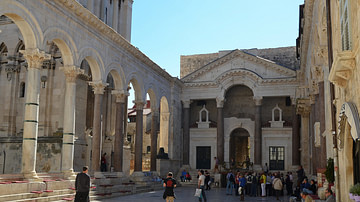
Diocletian's Palace, Split
The peristyle is the heart of Roman emperor Diocletian's Palace (Split, Croatia) built at the turn of the fourth century CE.
Image
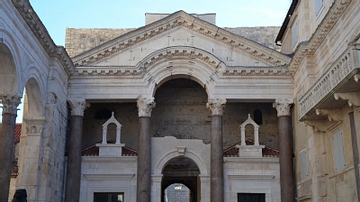
Peristyle of Diocletian's Palace
The peristyle is the heart of Roman emperor Diocletian's Palace (Split, Croatia) built at the turn of the fourth century CE.

Image
Egyptian sphinx from Diocletian's Palace
Diocletian's Palace was decorated with numerous granite sphinxes originating from the site of Egyptian Pharaoh Thutmose III. Only three have survived the centuries. This one is still located on the Peristyle...

Image
Map of the Diocletian's First Tetrarchy and the Roman Empire - Stability Through Division, Succession by Design
The First Tetrarchy (293–305 CE) was Emperor Diocletian's (reign 284–305 CE) solution to the political and military crises that had nearly destroyed the...

Article
Doge's Palace in Venice
The Doge's Palace, or Palazzo Ducale, in Venice, Italy, was the seat of power of one of the world's most powerful city-states, as the Venetian Republic dominated the Mediterranean for centuries. The bright façade of the...
Article
Government and Taxes under Diocletian and Constantine
The state created by Diocletian and Constantine used to be described as despotic and oppressive, extracting higher taxes and threatening its subjects with punishments for non-compliance. Recent research...

Article
Wall Reliefs: Apkallus of the North-West Palace at Nimrud
Religion is the sigh of the oppressed creature, the heart of a heartless world, and the soul of soulless conditions. It is the opium of the people. (Karl Marx, Critique of Hegel's Philosophy of...

Image
Gold Ring and Coin of Diocletian
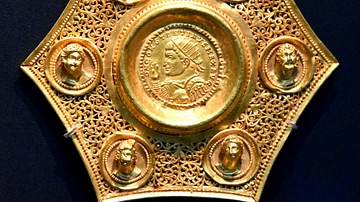
This is a gold ring with an aureus (gold coin) of the Roman Emperor Diocletian (r. 284-305 CE). The reverse of the coin (not shown here) shows four soldiers sacrificing in front of a camp. Roman period, 4th century...
